Hale Bopp

Photographs: March 6 to 10, 1997


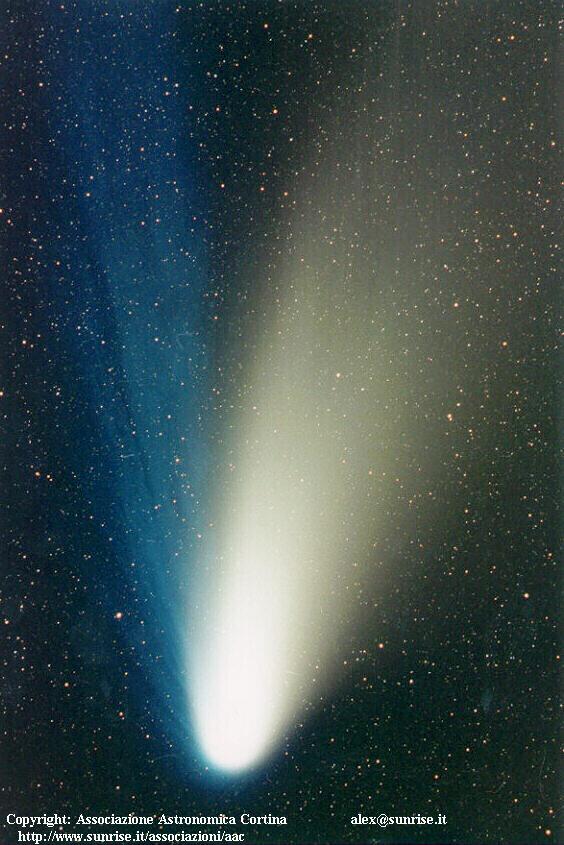
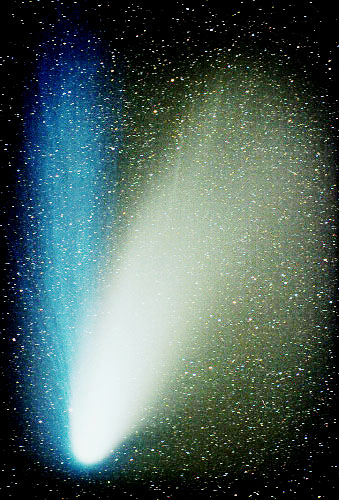
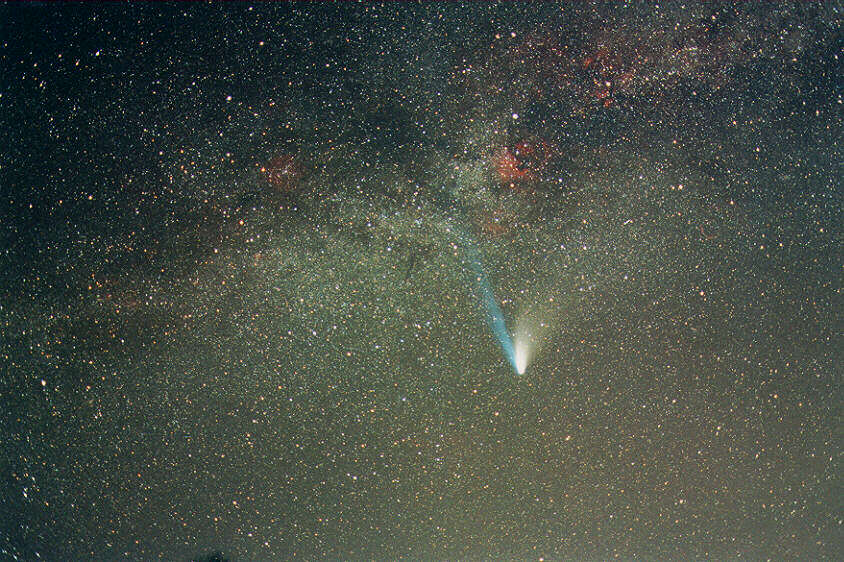
March 10, 1997

Author: Alessandro Dimai and Davide Ghirardo
Location: Col Drusciè Observatory, Cortina d'Ampezzo (Italia)
Optics: Takahashi 102mm f/6. Kodak Express Gold 400 II hypered film. 6 minutes of exposure.

The comet's coma was of magnitude -0.5, with a naked eye visible ion tail of ~15 deg. and a diffuse dust tail of ~6 deg.


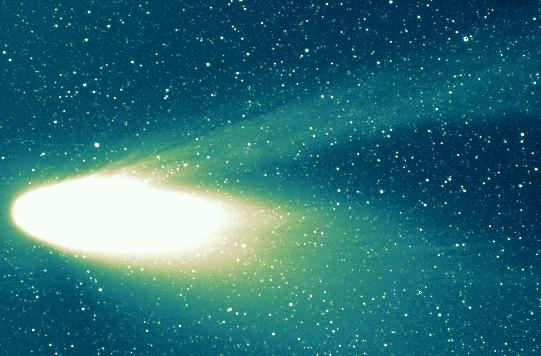
March 10, 1997

Author: Herman Mikuz
Location: Crni Vrh Observatory (Slovenia)
Optics: 180mm f/2,8 lens, CCD camera and H2O+ filter.

Wide-field (3.8 x 2.5 degrees) false-color image taken in the light of singly-ionized water ions. Exposure time was 5 minutes.

Copyright © 1997 by H. Mikuz.


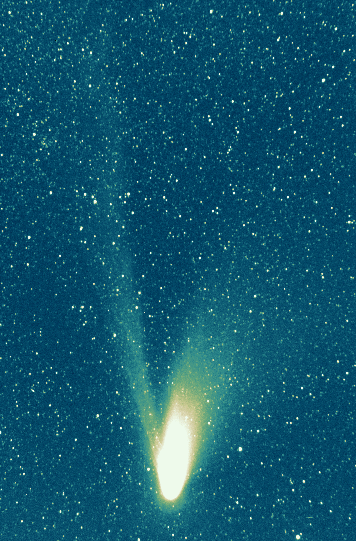
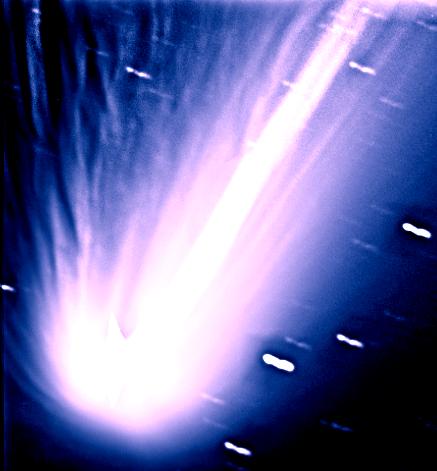
March 10, 1997

Author: Herman Mikuz
Location: Crni Vrh Observatory (Slovenia)
Optics: 65mm f/3.5 lens and CCD camera.

Wide-field (9.7 x 6.5 degrees) false-color image taken at 10.170UT (start) in the light of singly-ionized water ions. Exposure time was 5 minutes.

Copyright © 1997 by H. Mikuz.


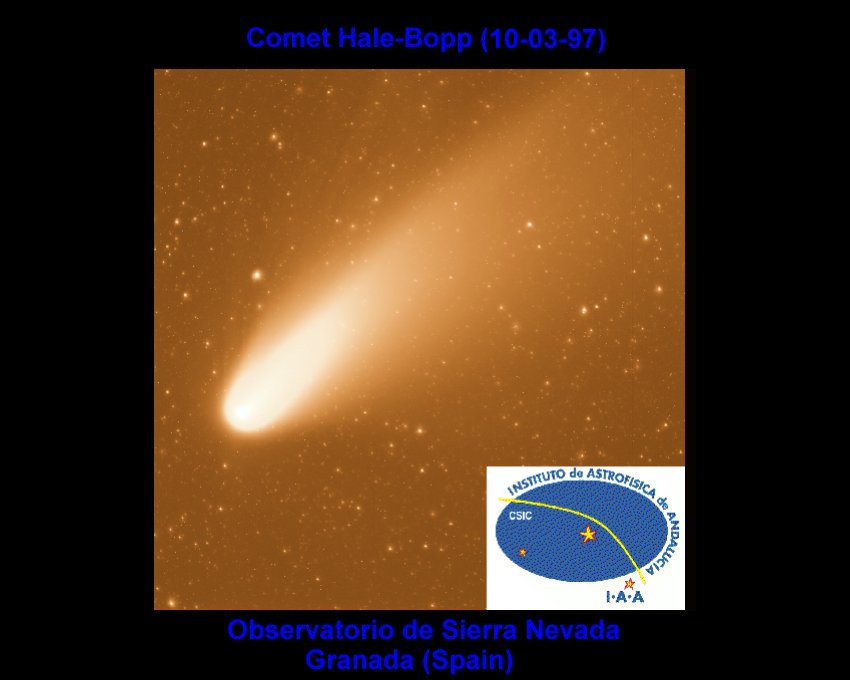
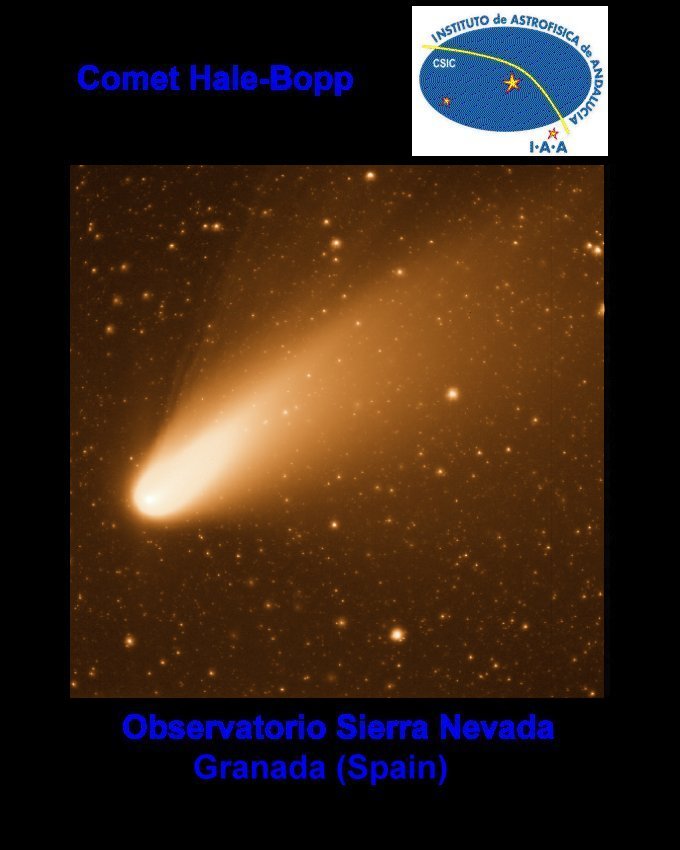
March 10, 1997
5:20 UT

Authors: José Luis Ortiz, Ernesto Sánchez-Blanco
Location: Observatorio de Sierra Nevada,
Instituto de Astrofisica de Andalucia, CSIC. Granada (Spain)
Optics: 300 mm f/5.6 lens. Càmera CCD 1024x1024.

The inner part of the coma was saturated in order to observe the tail.


March 10, 1997
9:30 UT


March 10, 1997
9:17 UT

Author: Ian Griffin
Location: Astronaut Memorial Planetarium & Observatory, Cocoa (Florida)
Optics: Maksutov 12" f/5 telescope and SBIG ST8 camera. Lumicon Swann band filter.

5 minutes exposure, starting at 09:50 UT. The field of view is 0.3 degrees (long axis) by 0.2 degrees (short axis). The image has been processed using Mira. A 40 by 40 median filtered masked image was substracted from 105% of the original first image. Second one has been flat fielded and dark substracted.


March 10, 1997
03:42 to 04:08 UT
55 x 55 degrees
[JPEG; 248k]


March 10, 1997
02:48 to 03:03 UT
12 x 12 degrees
[JPEG; 216k]

Author: Eckhard Slawik
Location: Wüttemberg (Germany)

26 and 15 minutes of exposure. These images are undoubtedly among the most impressive so far obtained of this comet. Note in particular the wide-angle photo with the Milky Way in the background.

These images are © Eckhard Slawik.
They may be reproduced on the condition that the author is mentioned.


March 9, 1997

Author: Tim Puckett
Optics: 12" LX200 reflector working at f/6.

This false color image of Hale-Bopp is a composite of 27 -30 second exposures taken with an Apogee AP-7 CCD. The first exposure was taken on 03-09-97 at 10:16:29 UT, the last exposure was taken 10:32:51. The images were enhanced to show the jets from the nucleus.

Copyright©1997Tim Puckett


March 9, 1997

Author: Anthony Parra
Location: Sta. Fe del Montseny, Catalunya (Spain)
Optics: 50 mm f/1.7. Kodak Gold 400. 2 minutes of exposure.

This image, taken at the beginning of twilight, is not quite good, but is the only one I could take using a home-made equatorial device powered by an alarm clock and sticking plaster. The lab did its best to get a print light and soft, looking like a diurnal photograph. They can't understand that the sky is darker at night. Then, once scanned, I rescued what I could. It would have been a nice photo showing both tails over the Milky Way, at Cygnus.


March 9, 1997
3h37-3h50 UT

Author: H. Mikuz & B. Kambic
Location: Crni Vrh Observatory.
Optics: 20-cm, f/2 Baker-Schmidt camera and Fujicolor 400 SG+ film.

The field of view is about 5x3.5 deg.

Copyright ©1997 by H. Mikuz & B. Kambic.


March 9, 1997

Author: Tim Puckett
Optics: 30cm reflector working at f/6.

This false color image of Hale-Bopp is a composite of 30 -30 second exposures taken with an Apogee AP-7 CCD. The first exposure was taken on 03-16-97 at 10:21:52 UT, the last exposure was taken 10:49:52. The images were enhanced to show the jets from the nucleus.

Copyright©1997 Tim Puckett


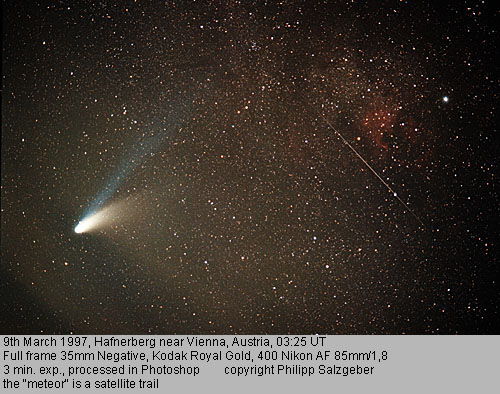
March 9, 1997
03:25 UT

Author: Phillip Salzgeber
Location: Hafnerberg, near Vienna (Austria)
Optics: Nikon AF 85mm f/1.8. Exposure: 3 minutes on Kodak Royal 400 film.

The meteor is a satellite trail.

Copyright© Phillip Salzgeber


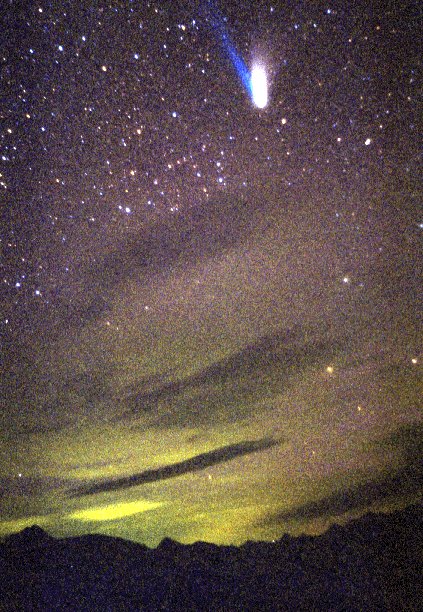
March 9, 1997
04:30 UT

Author: Herbert Span
Location: Hintereisferner, Oetzal (Austria)
Exposure: 3o segundos con Kodak Pro Gold 400 .

This photo was taken from Hintereisferner, a place 3020m high.

Copyright© Herbert Span


March 8, 1997
09:08 UT

Author: Stephane Potvin
Location: St. Luc Dorchester, Quebec (Canada)
Optics: 6" f/7 astro-physic's refractor telescope at prime focus and CCD SBIG ST7 camera.

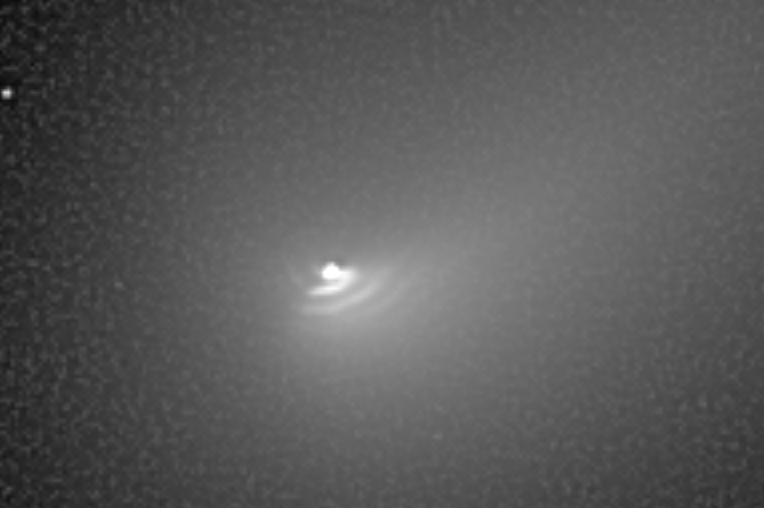
This is a 10 second exposure of Hale-Bopp's coma on 8th march 1997 at 09:08 U.T. It was incredible, I've never seen that. Image has been flat fielded and log scaled.


March 8, 1997
4:01 UTC

Author: Andjelko Glivar
Location: Donja Stubica (Croatia)
Optics: 58mm/f:2 lens and Fujicolor super G plus 800 film.

4 minutes exposure. On this image we can see Deneb and NGC7000. At the end of the tail can be seen open cluster M39.


March 8, 1997
9:30 UT


March 8, 1997
9:17 UT

Author: Ian Griffin
Location: Astronaut Memorial Planetarium & Observatory, Cocoa (Florida)
Optics: Maksutov 12" f/5 telescope and SBIG ST8 camera. Lumicon Swann band filter.

5 minutes exposure, starting at 09:50 UT. The field of view is 0.3 degrees (long axis) by 0.2 degrees (short axis). The image has been processed using Mira. A 40 by 40 median filtered masked image was substracted from 105% of the original first image. Second one has been flat fielded and dark substracted.


March 7, 1997
9:24 UT

Author: Jerry Lodriguss
Location: Batsto, New Jersey
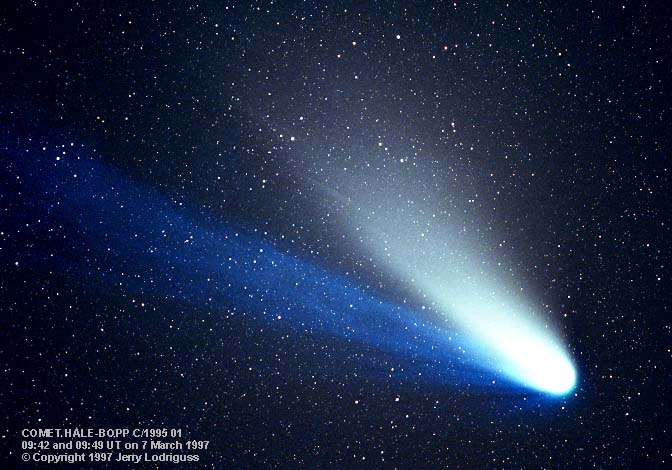
Optics: Nikon 400mm f/2.8 ED lens. Fujicolor Super G 800 Plus film.
Composite of two 5 minute exposures. The original images were scanned and digitized and combined in Photoshop.


March 7, 1997
9:24 UT

Author: Jerry Lodriguss
Location: Batsto, New Jersey
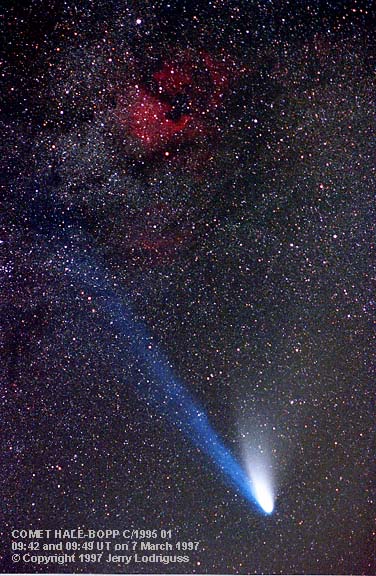
Optics: 105 mm f/1.8 lens. Kodak Pro 400 PPF.
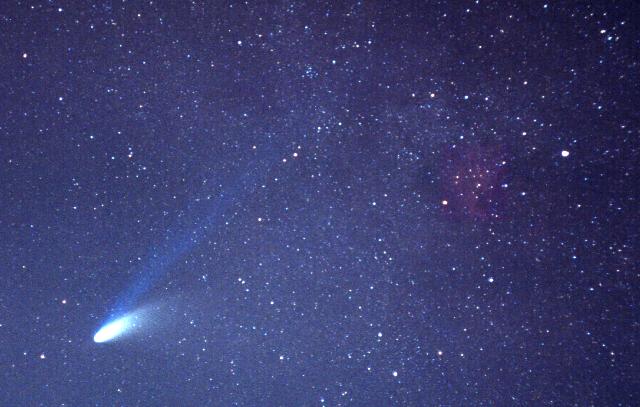
Comet Hale-Bopp, showing approximately 11 degrees of ion tail, cruises past the North American and Pelican nebulae. Composite of two 5 minute exposures taken at 09:24 and 09:31 UT on 7 March 1997. The original images were scanned and digitized and combined in Photoshop.


March 7, 1997

Author: Alessandro Dimai and Davide Ghirardo
Location: Col Drusciè Observatory, Cortina d'Ampezzo (Italia)
Optics: Takahashi 102mm f/6. Kodak Express Gold 400 II hypered film. 6 minutes of exposure.

The comet's coma was of magnitude -0.3, with a naked eye visible ion tail of ~12 deg. and a diffuse dust tail of ~6 deg.


March 7, 1997

Author: Alessandro Dimai, Davide Ghirardo
Location: Col Drusciè Observatory, Cortina d'Ampezzo (Italia)
Optics: 35 mm lens f/2.8. Kodak Express Gold 400 II hypered film. 3 minutes of exposure.


March 7, 1997
5:20 UT


March 6, 1997
4:50 UT

Authors: José Luis Ortiz, Ernesto Sánchez-Blanco
Location: Observatorio de Sierra Nevada,
Instituto de Astrofisica de Andalucia, CSIC. Granada (Spain)
Optics: 300 mm f/5.4.


60 seconds exposure on a 1024x1024 CCD camera. The field of view is 2.4 x 2.4 degrees. The inner part of the coma was saturated in order to observe the tail. North is up, West is to the right.


March 7, 1997

Autor: Mitsuya Saeki ,
Nishiwaki Amateur Astronomical Group ,
Location: Kami-cho. Hyogo (Japan)
This image (1024 x 768 JPG) can suit as wallpaper for Windows.
You must convert it to BMP and perhaps resize it to fit your screen.


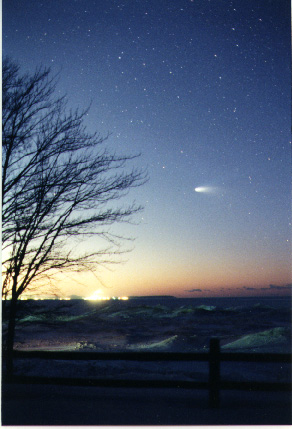
March 6, 1997
(evening)

Author: Brian Halbrook
Location: Lake Superior icepack
Optics:28mm lens f/2.5, Royal Gold 1000 film.

35-seconds exposure. I was shocked at how observable the comet was since my last nightime excursion on Feb. 25. and how BRIGHT the comet now was. The first image is just after sunset, the lights of Marquette, MI visible across a large frozen bay of Lake Superior.