Last update: March 27, 1997
|
|
Author: Steve Larson and Carl Hergenrother Location: Steward Observatory Optics: 2.3-m telescope. This splendid image [JPG; 26k] is a 'quick-look version' of the full scale image that is available at http://www.lpl.arizona.edu/bss/HB0315CO.html. It was obtained in the light of CO+ on March 15.5 UT. The banded structure in this high-pass filtered version near the nucleus is due to dust, but the complex, wavy outer structure is caused by CO+ ions being driven back into the tail by the solar wind magnetic field. The ion features change on a timescale of minutes. North is up, east to the left, and the field is about 350,000 km at the comet. |
|
|
Author: Ian Griffin Location: Astronaut Memorial Planetarium & Observatory, Cocoa (Florida) Optics: Maksutov 12" f/5 telescope and SBIG ST8 camera. 5 minutes exposure. Telescope guided on motion of comet during the exposure
which accounts for star trails. The field of view is 0.3 degrees (long
axis) by 0.2 degrees (short axis). |
|
|
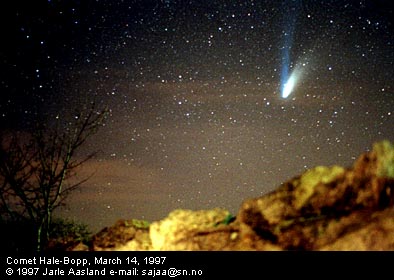
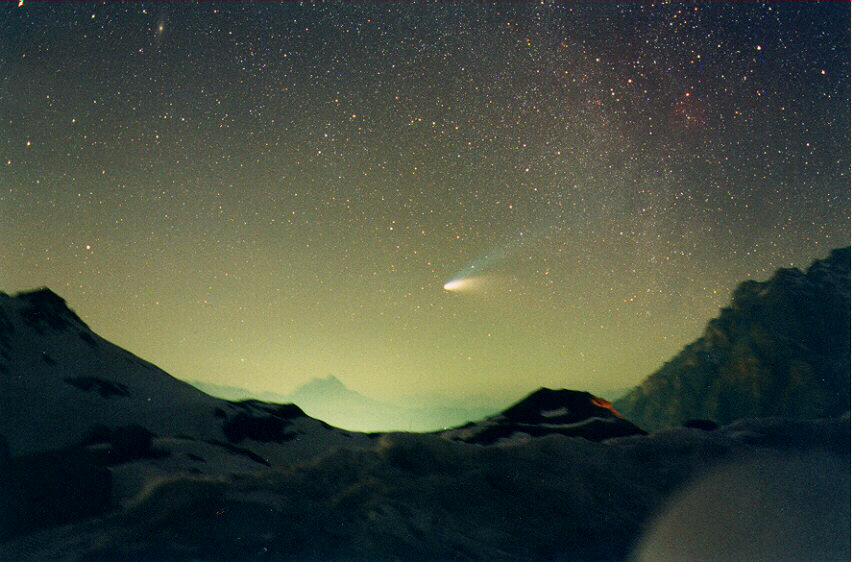
Author: Jarle Aasland Location: Norway Optics:Unguided Nikon F4. 50mm lens. Fujicolor Super G Plus 800 ISO. 1 minute of exposure. |
|
|
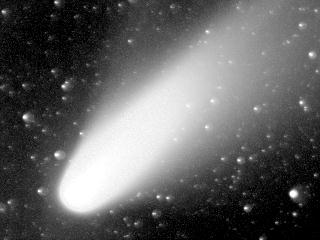
Author: Stephane Potvin Location: St. Luc Dorchester, Quebec (Canada) Optics: 6" f/7 astro-physic's refractor telescope and CCD SBIG ST7 camera. This is a 3 second exposure of Hale-Bopp's coma. Image has been flat fielded log scaled and sharpened. |
|
|
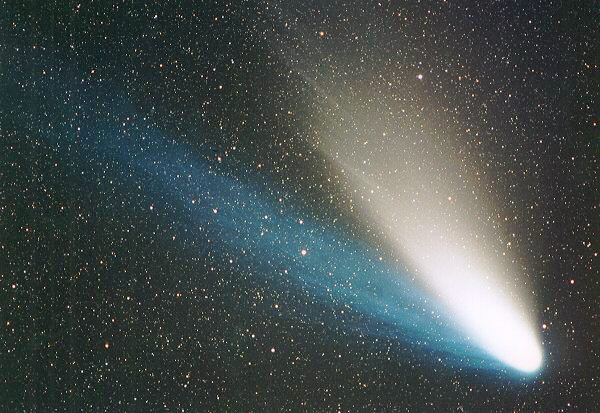
Author: H. Mikuz & B. Kambic Location: Crni Vrh Observatory. Optics: 20-cm, f/2 Baker-Schmidt camera and Fujicolor 400 SG+ film. The field of view is about 5x3.5 deg. Copyright ©1997 by H. Mikuz & B. Kambic. |
|
|
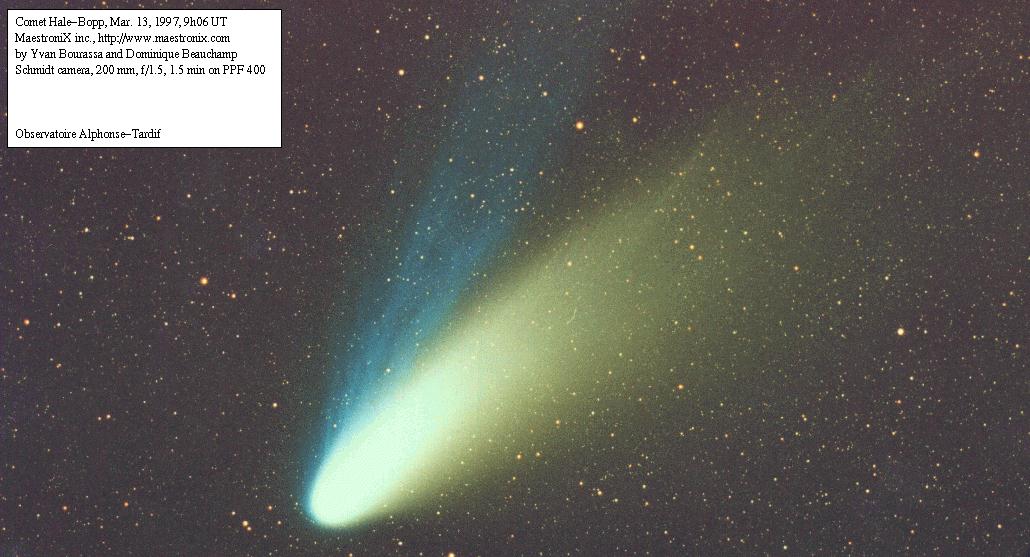
Author: Yvan Bourassa and
Dominique Beauchamp
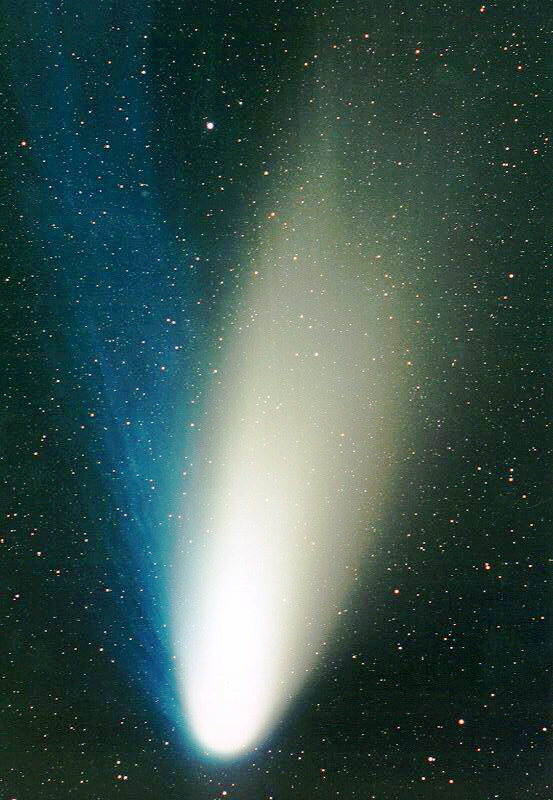
of MaestroniX inc. Location: Observatoire Alphonse-Tardif, St-Neree, Québec (Canada) Optics:20cm f/1.5 Celestron Schmidt camera in piggy-back on a C14. Kodak PPF ISO 400 film. 1.5 min. of exposure. Streams and knots are well seen in both tails. |
|
|
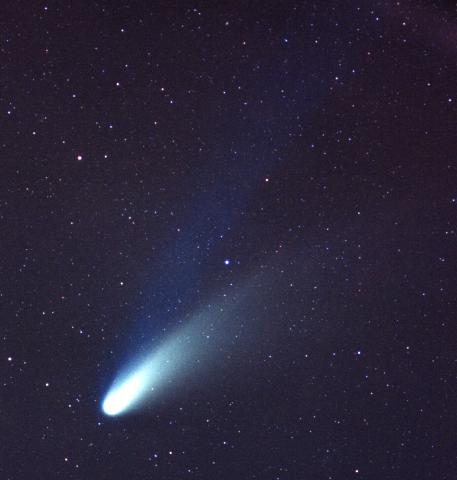
Author: Alessandro Dimai, Davide Ghirardo and Renzo Volcan Location: Passo Giau (2230 mt), Cortina d'Ampezzo (Italy) Optics: Tele 300 mm f/2,8 - Kodak Gold 400 II hiper. 4 minutes of exposure. |
|
|
Author: Ian Griffin Location: Astronaut Memorial Planetarium & Observatory, Cocoa (Florida) Optics: Maksutov 12" f/5 telescope and SBIG ST8 camera. Lumicon Swann band filter. 5 minutes exposure, starting at 09:35 UT. The field of view is 0.3 degrees (long axis) by 0.2 degrees (short axis). The image has been processed using Mira. A 40 by 40 median filtered masked image was substracted from 105% of the original first image. Second one has been flat fielded and dark substracted. |
|
|
Author: Andjelko
Glivar Location: Donja Stubica (Croatia) Optics: 200mm/f:3.5 lens and Fujicolor super G plus 800 film. 10 minutes exposure. |
|
|
Author: Alessandro Dimai, Piergiorgio Cusinato, Francesco
D'Arsiè and Gabriele Rosolen Location: Passo Giau (2230 mt), Cortina d'Ampezzo (Italy) Optics:Takahashi FS 102 f/6 - Kodak Gold 400 II hiper. 6 minutes of exposure.The comet's coma was of magnitude - 0.6, with a naked eye visible ion tail of ~15 deg. and a diffuse dust tail of ~7 deg. |
|
|
Author: Alessandro Dimai, Piergiorgio Cusinato, Francesco
D'Arsiè and Gabriele Rosolen Location: Val Parola Pass, Cortina d'Ampezzo (Italy) Optics: 35 mm f/2.8 lens. Kodak Gold 400 II hypered film. 3 minutes of exposure. |
|
|
Author: Jan Veseley Location: Hradec Kralove (Czech Republic) Optics: 85mm f/2 lens. PixCel 255 CCD camera. 1 minute of exposure. |
|
|
Authors: José Luis Ortiz, Ernesto Sánchez-Blanco Location: Observatorio de Sierra Nevada, Instituto de Astrofisica de Andalucia, CSIC. Granada (Spain) Optics: 300 mm f/5.6 lens. 1024x1024 CCD camera. The inner part of the coma was saturated in order to observe the tail. |
|
|
Author: Alessandro Dimai Location: Val Parola Pass, Cortina d'Ampezzo (Italy) Optics: 35 mm f/2.8 lens. Kodak Gold 400 II hypered film. 2 minutes of exposure. |
|
|
Author: Takuo Kojima Location: Chiyoda, (Japan) Optics: 165mm f/2.8 photo lens + ST-8 CCD camera. 1 minute of exposure. Field of view: 4.8 deg. x 3.2 deg. RGB composite image. There are some ghost images in the upper right corner. North is up. 450 seconds of exposure. |
|
|
Author: Brian Halbrook Location: Lake Superior icepack Optics:28mm lens f/2.5, PJM640MS film. 2 minutes, tracked exposure. |
|
|
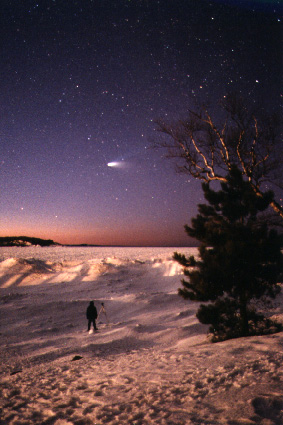
Author: Brian Halbrook Location: Lake Superior icepack Optics:28mm lens f/2.5, Royal Gold 1000 film. 35 seconds exposure. A Hale-Bopp observing session at Presque Isle Park turned into an impromptu public observing. |