Hale Bopp

Photographs: March 21 to 25, 1997


Last update: March 27, 1997


March 26 1997
03:45 UT


March 26 1997
04:30 UT

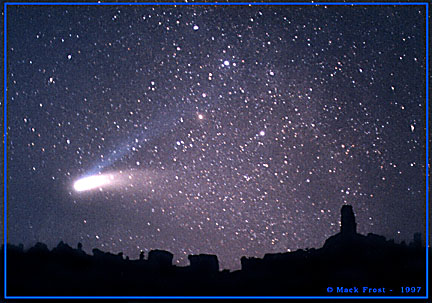
Author: Mack Frost
Location: Shoshone National Forest, Wyoming
Optics:50mm/f1.4 lens on Fuji 800 Super HG+ film.

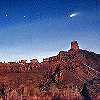
40 seconds exposure. Each image is of a volcanic feature called "The Holy City," located 26 miles west of Cody, Wyoming on US Hgwy 14-16-20 in the Shoshone National Forest. The only difference between the pictures is that in the second, the moon has risen and illuminated the top of the formation.


March 25, 1997
00:23 UT

Author: Ian Griffin
Location: Astronaut Memorial Planetarium & Observatory, Cocoa (Florida)
Optics: Maksutov 12" f/5 telescope and SBIG ST8 camera.

120 second exposure of comet Hale-Bopp. The field of view is 0.3 degrees (long axis) by 0.2 degrees (short axis). Flat fielded and dark subtracted. A 20 by 20 median filtered masked image was subtracted from 105% of the original. A false colour palette was then added.


March 25, 1997
03:30 UT

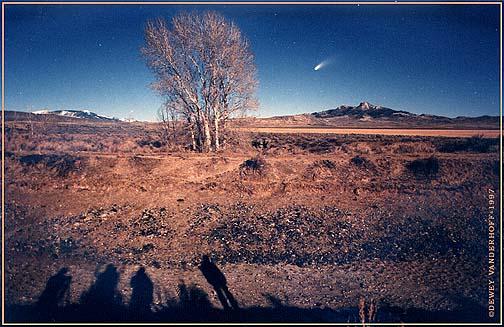
Author: Dewey Vanderhoff
Location: Wapiti Valley west of Cody Wyoming near Yellowstone Park.
Optics: 55mm f/2.8 and Fuji Super G-400 color negative.

Here's another"change of pace" comet photo. Just happened to catch a nice little bolide meteor in the edge of the picture during the exposure. It shows a nice flare at the end.

The mountain is Heart Mountain, a prominent and famous geologic landmark eight miles north of Cody, Wyoming near the Montana border.

Hale Bopp is currently only below the north horizon for about two hours here in northern Wyoming during its circumpolar swing.

Copyright©1997 Dewey Vanderhoff


March 25, 1997
05:05 UT

Author: Dewey Vanderhoff
Location: Cody, Wyoming.
Optics: 24mm f/2.8 Nikkor lens.
Exposure: 45 seconds on Fuji Super G-400 color print film.

Here's a view of three photographers and a computer guy caught in the act of image-napping Hale-Bopp. We are standing on the bank of a large irrigation canal... our shadows are projected on the opposite bank (very nice geometry, eh?) by the Moon one night past full. That's Heart Mountain in the background, a renowned geologic landmark in northern Wyoming.


March 25, 1997

Author: H. Mikuz & B. Kambic
Location: Crni Vrh Observatory (Slovenia).
Optics: 20-cm, f/2 Baker-Schmidt camera and Fujicolor 400 SG+ film.

Color image obtained in moonlight conditions. The field of view is about 4.5x3.0 deg.

Copyright ©1997 by H. Mikuz & B. Kambic.


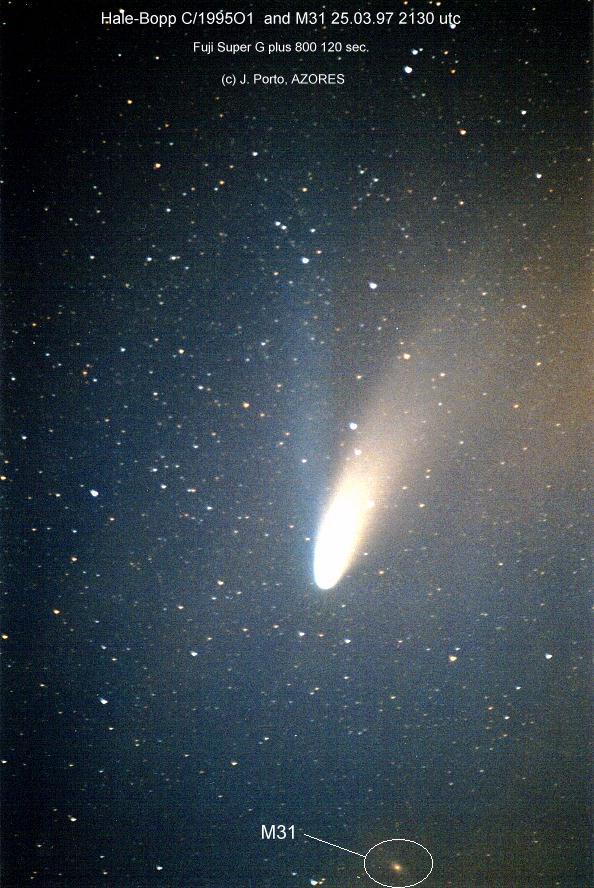
March 25, 1997
21:30 UT

Author: Joao Porto
Location: Azores Islands
Exposure: Fuji Super G plus 800, 120 seconds.

M31 (Andromeda) can be seen inside an oval.

Copyright© 1997 Joao Porto


March 25, 1997
13:56 UT

Author: Bill Hutchinson (hutch@corecom.net)
Location: Kenai National Wildlife Refuge, Alaska
Optics: Nikon N90 50mm f2, 25 seconds exposure on Fuji 800HG.

Just before moonrise Hale-Bopp can be seen more clearly now in the richness of the Milky Way. The Andromeda Galaxy is barely visible below the comet (yellow arrow).

Copyright© 1997 Bill Hutchinson
The Kenai Peninsula Eagle Press®


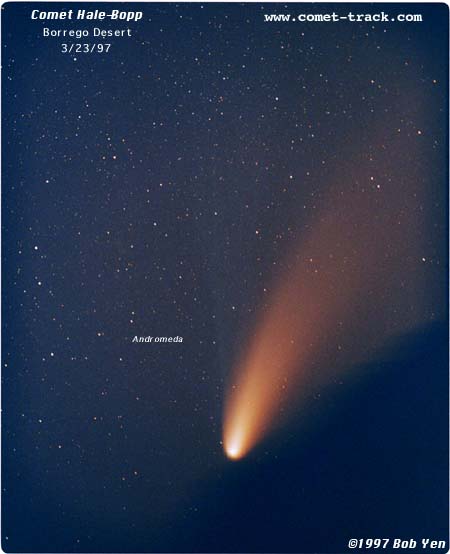
March 24, 1997
04:38 UT

Author: Bob Yen
Location: Mojave Desert, California
Optics: AstroPhysics 610mm f/6 lens w/field-flattener and a 6x7 camera.

Taken during totality phase of lunar eclipse (~8:38 pm). Comet is JUST beginning to set below hill-line. The ion tail is barely visible due to heavy atmospheric extinction, but the very bright dust tail still records well. The color also reflects the thick atmospheric condition, i.e. light scattering (yellowish reddish).


March 23, 1997
(evening)

Author: Brian Halbrook
Location: Lake Superior icepack
Optics:135mm f2.8 lens with Kodak PJM640 film.

7 minutes exposure. Viewing the Comet during the Lunar eclipse. The change in the sky was dramatic during mid-eclipse. There were many more stars visible. The comet, despite its low altitude, sported a 10-degree dust tail and a 12-14 degree ion tail to the naked eye!
On the first image, that's icy Lake Superior in the lower right corner. On the second, the the author is besides the tripod.


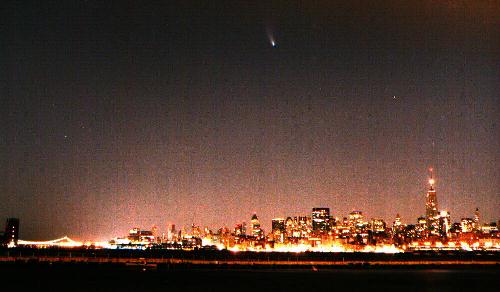
March 23, 1997
09:15 UT

Author: Joseph Sivo
Location: Jersey City, New Jersey
Optics: Pentax K-1000 with 50mm f/2.8 lens. Kodak 400 ASA Royal Gold film.

15 seconds exposure unguided, scanned at 200 dpi and processed, taken from the banks of the Hudson River on the New Jersey side, of Comet Hale-Bopp over New York City. The Empire State Building is visible on the lower right, and the George Washington Bridge is visible on the lower left.


March 23, 1997
00:23, 10:07 UT

Author: George Varros
Location: Mt. Airy, Maryland
Optics: 8" SCT f/10 EDC-1000 CCD.

Left image 03/23/97 00:23 UT, Right image 03/23/97 10:07 UT 1 second exposures. Unsharp Mask applied. 9hrs 44 minutes elapsed between images. Note the shape and alignment of the pseudonucleus. The right image plume at bottom of nucleus ends up as the second shell out in the second image.


March 23, 1997
01:00 UT

Author: Ian Griffin
Location: Astronaut Memorial Planetarium & Observatory, Cocoa (Florida)
Optics: Maksutov 12" f/5 telescope and SBIG ST8 camera.

10 seconds exposure. The field of view is 0.3 degrees (long axis) by 0.2 degrees (short axis). Flat fielded and dark subtracted. The image has been processed using Mira. A 20 by 20 median filtered masked image was subtracted from 105% of the original. A false colour palette was then added.


March 21, 1997


March 21, 1997


March 22, 1997

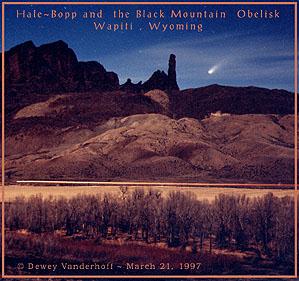
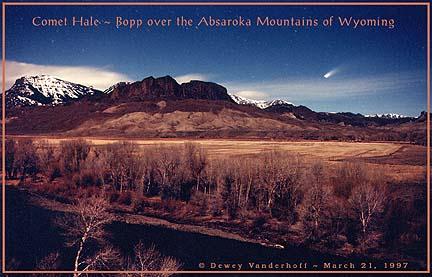
Author: Dewey Vanderhoff
Location: Wapiti Valley west of Cody Wyoming near Yellowstone Park.
Optics: 35mm f/2 lens used at 2.8 and Fuji Super G-800.

The technique is to use a blessing of abundant moonlight to illuminate a rich landscape, with short enouigh exposures to prevent star trail motion. You can only do this within 2-3 days either side of a full moon each month

This works out to exposures of 40-60 seconds at f/2.8 using 400 speed films. I use Nikkor lenses, 24-35-55mm focal lengths ; Nikon camera on tripod. Composition is based on a preexisting knowledge of the landscape , and a lot of Pure Dumb Luck. But after twenty years I finally have a feel for this sort of stuff. Forty seconds when the moon is high, sixty seconds when it's lower ; and bracket your shots like a half-blind goose hunter.

These are in the tradition of the great landscapes of the American West painted in the 1800's, more impressionist pigmenting than photographic imaging. I hope you find they provide a great complement to the multitudes of "Boone and Crockett" trophy comet head imagery.

Copyright©1997 Dewey Vanderhoff


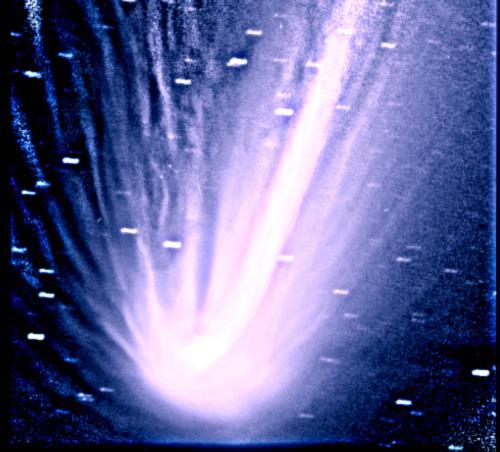
March 22, 1997

Author: Tim Puckett
Optics: 30cm reflector working at f/6.

This false color image of Hale-Bopp is a composite of 20 - 15 second exposures taken with an Apogee AP-7 CCD. The first exposure was taken on 03-22-97 at 00:51:38 UT, the last exposure was taken 01:05:07. The images were enhanced to show the jets from the nucleus.

Copyright©1997 Tim Puckett


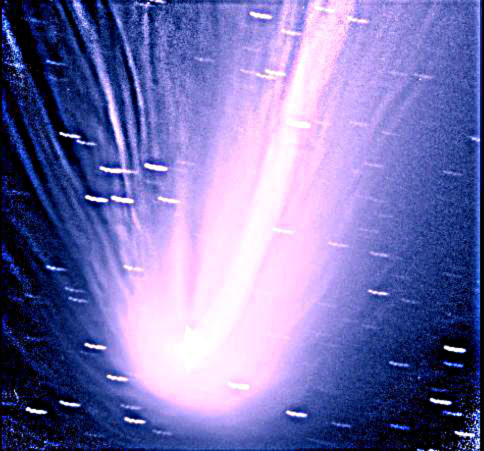
March 21, 1997

Author: Tim Puckett
Optics: 30cm reflector working at f/6.

This false color image of Hale-Bopp is a composite of 20 - 15 second exposures taken with an Apogee AP-7 CCD. The first exposure was taken on 03-21-97 at 00:50:39 UT, the last exposure was taken 00:59:45. The images were enhanced to show the jets from the nucleus.

Copyright©1997 Tim Puckett


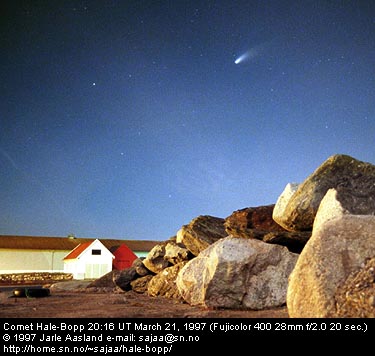
March 21, 1997
20:16 UT

Author: Jarle Aasland (sajaa@sn.no)
Location: Stavanger, Norway
Optics:28mm f/2. Fujicolor 400.

20 seconds of exposure.


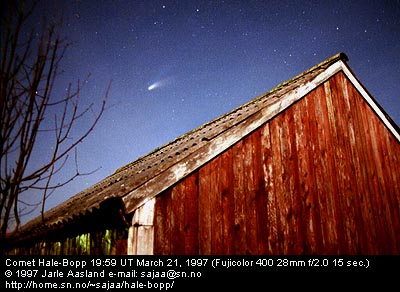
March 21, 1997
19:59 UT

Author: Jarle Aasland (sajaa@sn.no)
Location: Stavanger, Norway
Optics:28mm f/2. Fujicolor 400.

15 seconds of exposure.


March 21, 1997
5:05 UT

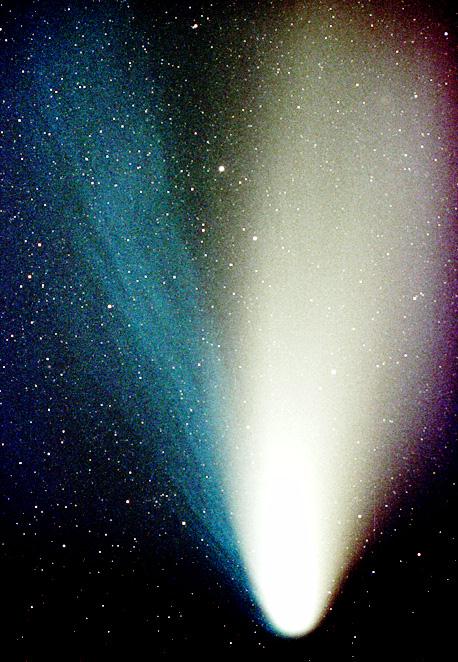
Authors: José Luis Ortiz, Ernesto Sánchez-Blanco
Location: Observatorio de Sierra Nevada,
Instituto de Astrofisica de Andalucia, CSIC. Granada (Spain)
Optics: 300 mm f/5.4 lens. 1024x1024 CCD camera.

Field of view: 2.4 x 2.4 degrees. North is up, West is to the right. The inner part of the coma was saturated in order to observe the tail.