Hale Bopp

Photographs: April 6 to 10, 1997


Last update: April 20, 1997


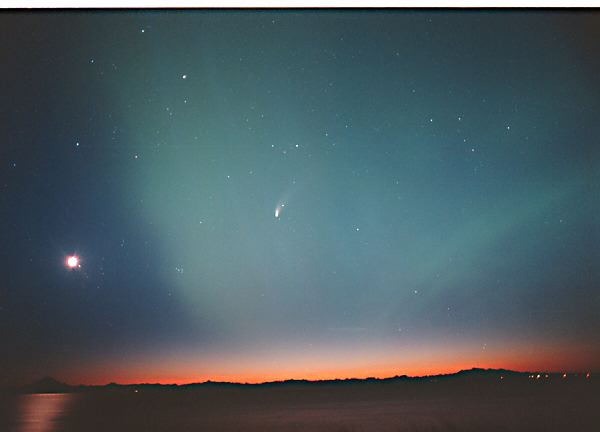
April 10 1997

Author: Bill Hutchinson (hutch@corecom.net)
Location: Kenai National Wildlife Refuge, Alaska
Optics: Nikon N90 20mm f/2.0, 20 seconds on Fuji 400 Super G.

Sharing the sky with moon light and sunset, the aurora borealis started its show late April 10th with a colorful cloud that rose in the south and then drifted north to light up Cook Inlet.

Copyright© 1997 Bill Hutchinson
The Kenai Peninsula Eagle Press®


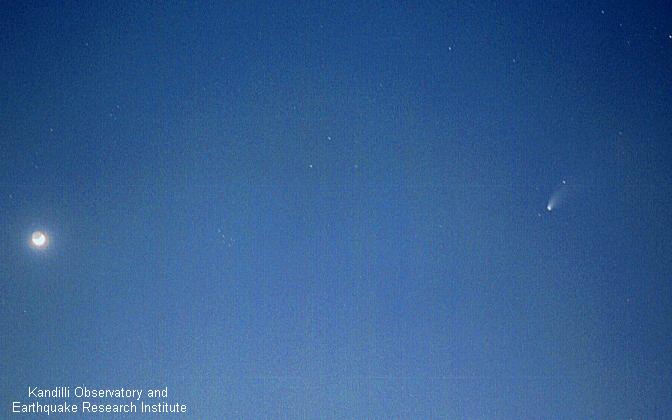
April 10, 1997
18:00 UT

Authors: Tamer Atac, Oryal Barlas, Hasmet Bolge
Location: Kandilli Observatory, Istanbul, Turkey
Optics: 50 mm F/1.2 Leitz Summicron at f/3. 30 seconds on 1600 Fuji film.


April 10, 1997
00:55 UT

Author: Geoff Chester, National Air & Space Museum, Washington, DC, USA
Location: Oak Shade Observatory, Rixeyville, Virginia
Optics: 50mm f/1.8 Nikkor E-series lens, mounted on a tripod.

15-second exposure on Kodak PPF-400 Professional color negative film, unguided.


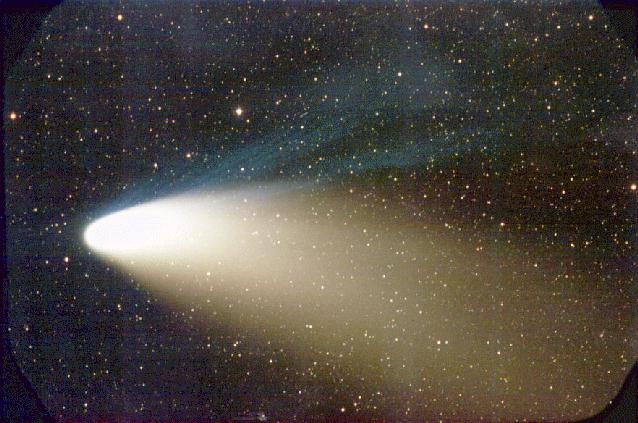
April 10, 1997
01:18 UT

Author: Geoff Chester, National Air & Space Museum, Washington, DC, USA
Location: Oak Shade Observatory, Rixeyville, Virginia
Optics: USNO Celestron 20-cm Schmidt Camera

2 minutes exposure on Kodak PPF-400 Professional color negative film.


April 10, 1997
02:05 UT

Author: David Hanon
Location: Soddy-Daisy, Tennessee
Optics: 300mm lens at f/2.8.

1 minute exposure.


April 10, 1997
21 UT

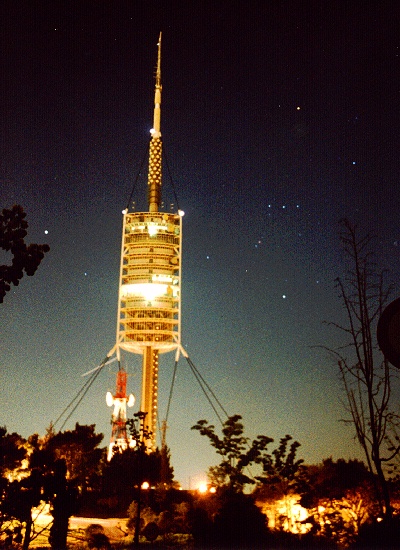
Author: Anthony Parra
Location: Foster's Tower at Barcelona, Catalunya (Spain)
Optics: 28 mm f/2.5. Kodak Ektar 1000. 10 seconds exposure.

Barcelona lies beside Mediterranean sea and is circled by several hills that outline it's skyline. Foster's Tower was built during the years preceding the Olimpic Games of Barcelona'92. We planned a comet-hunting session that night from a parking lot that is near this communications tower. The place is not dark, but it is not too far and about 500 meters high: that's much better than sea level. It wasn't easy to drive down Barcelona's streets that evening. The local football team played a semifinal match against Fiorentina at Camp Nou. That means a huge traffic jam many kilometers around the stadium.
Well... actually, the comet is NOT visible in this image. Only Sirius and Orion can be seen, and comet Hale-Bopp was at Perseus that night.
(click here for a better version)


April 10, 1997

Author: Anthony Parra
Location: Foster's Tower at Barcelona, Catalunya (Spain)
Optics: 28 mm f/2.5. Kodak Ektar 1000. 60 seconds exposure.

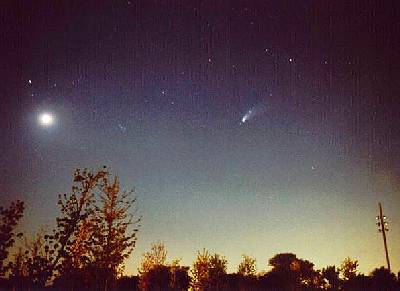
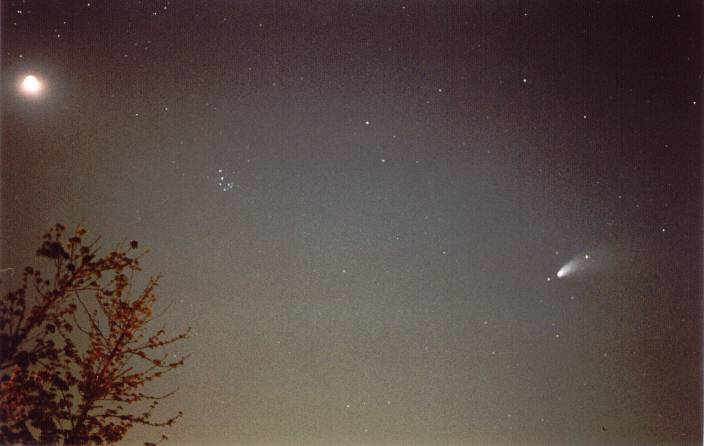
Hale-Bopps's tail was covering Algol (Beta persei) and pointing towards Mirfak (Alfa persei). The Moon, at left, was only three days old, but it is overexposed. Eight hours later, it passed half a degree north of Aldebaran (Alfa tauri), the bright star over it.


April 10, 1997

Author: Anthony Parra
Location: Foster's Tower at Barcelona, Catalunya (Spain)
Optics: 55 mm f/2.8. Kodak Ektar 1000. 10 seconds exposure.

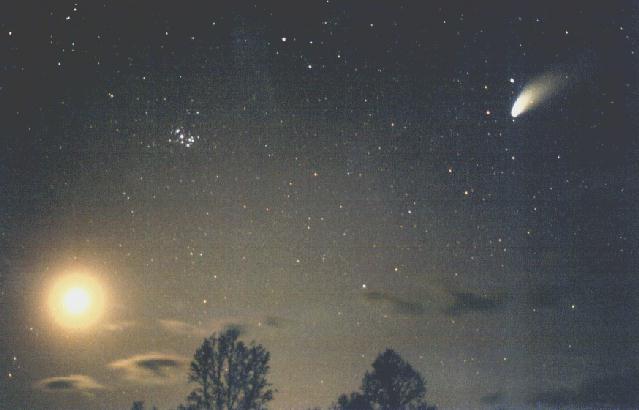
This image is quite the same, but with a better lens and a shorter exposure. The view through binoculars (my sight is not quite good) almost knocked my socks off: moon's horns seemed to be prolonged by Taurus' horns (Hyades). Open cluster M45 (Pleiades) is halfway the Moon and comet Hale-Bopp, over the trees.
(click here for a bigger version)


April 10, 1997

Author: Anthony Parra
Location: Foster's Tower at Barcelona, Catalunya (Spain)
Optics: 55 mm f/2.8. Kodak Ektar 1000.

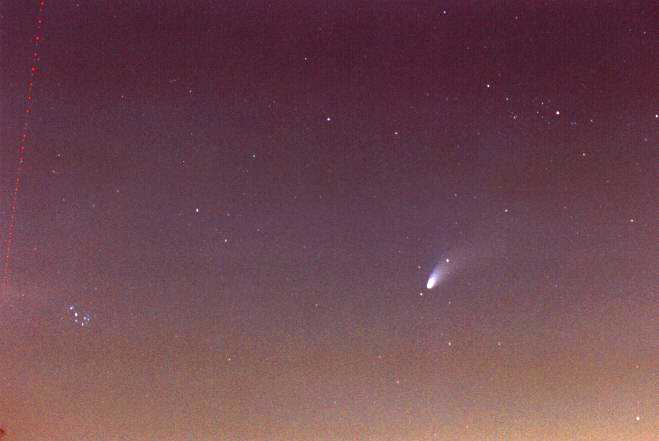
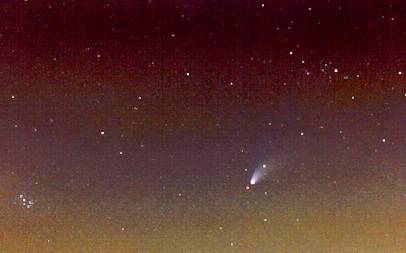
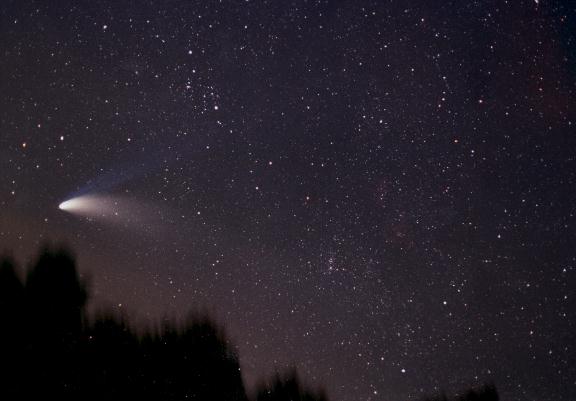
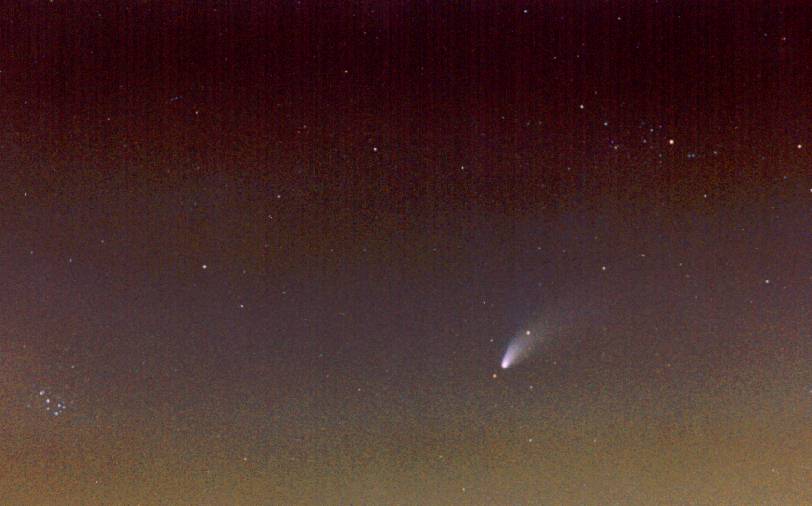
These images show comet Hale-Bopp over the left foot of Perseus. A plane caused the dashed line in the first one. Open cluster M45 (Pleiades) is at left. Exposure time was about one minute long, tracked with a home-made equatorial mount driven by a clock.
(click here for a bigger version)


April 10, 1997

Author: Anthony Parra
Location: Foster's Tower at Barcelona, Catalunya (Spain)
Optics: 205 mm f/3.8. Kodak Ektar 1000. 60 seconds exposure.

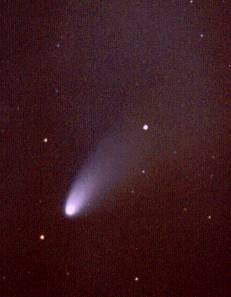
This image shows only part of the original print. The exposure was tracked with a home-made equatorial mount driven by a clock. The alignment wasn't quite good and the tripod is not quite stable (more challenge!). Despite all, the comet can be seen! (well... part of it).
Stay tuned: I promise an image of the engine next week.


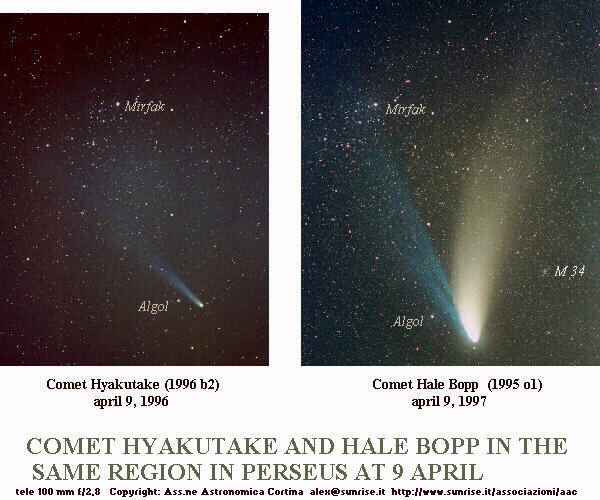
April 09, 1997
19:50 UT

Authors: Alessandro Dimai, Renzo Volcan and Davide Ghirardo
Astronomical Association of Cortina
Location: Col Drusciè Observatory, Cortina d'Ampezzo (Italy)
Optics: 100 mm f/2,8. 3 minutes of exposure on Kodak PRO Gold 400 II hiper film.

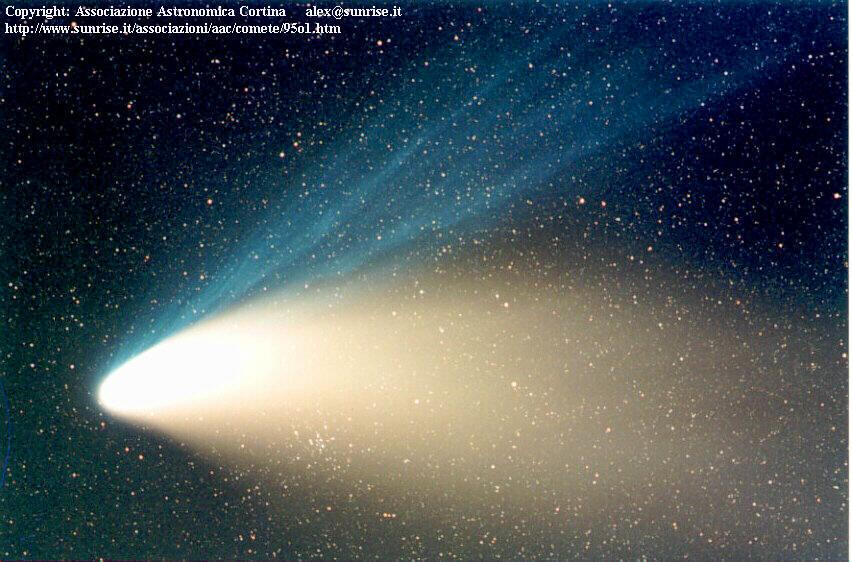
A comparison between Comet Hyakutake and Hale Bopp at the same date in the same region of Perseus.


April 9, 1997
04:15 UT

Author: Dewey Vanderhoff, Andy Frazier
Location:Cody, Wyoming.
Optics: Nikon F2AS camera 35mm f/2 Nikkor lens on Fuji Super G- 800 print film.

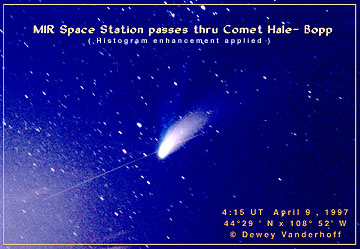
Here are the photos, as promised, of the wonderful moving conjunction of the Mir space station and Hale-Bopp on the evening of Tuesday April 8 as seen from a site ten miles east of cody WY at 10:15 PM

My friend Andy Frazier and myself had set up at Eagle Pass shortly after 8 PM to view the first of two visible illuminated passes of MIR that evening, where the 100-ton station and its newly docked Progress M-35 supply ship waltzed over us to the north at an elevation of 65.3 degrees.

Then we waited and comet watched and took in the conjunction of a 39-hour old crescent Moon andthe planet Mercury in the low northwest sky below Hale-Bopp. Ninety minutes after the first pass, MIR came around again...it was still illuminated some two hours after local sunset. At the time it was passing over eastern Washington state, the Idaho panhandle, and on up into British Columbia and Alberta some 535 miles distant when these images were taken.

Although still illuminated by the Sun, the phase angle and distance to MIR were such that it seemed to be a fast moving magnitude 4 or 5 star. However, we had no trouble locking in on it.

I use two valuable little shareware programs to determine MIR's location and time of appearance. The first is OrbitTak 2.1.5 from BEK Developers of Florida (for Macintosh... $10.00... download at www.shareware.com ) which is an excellent satellite plotting program. I get NASA 2-line orbital elements from various sources, all derived from NASA/Spacecom daily postings to stay current with over 125 satellite's worth of orbital parameters, including MIR. What you end up with is a clean graphic of the night sky from your location and viewing angles, with MIR's orbit laid in and time-ticked for 1-minute intervals. Last night It showed the comet going by Hale-Bopp's nucleus at a distance of roughly one-half a degree, and by the gods that's exactly what it did at the appointed moment!

The photo says it all. The first is a "normal" view of the scene with landscape, looking back west towards Cody Wy from Eagle Pass some ten miles distant. The second inage is cropped and histogram-enhanced in Photoshop 3.0.5 to emphasize the MIR trail.

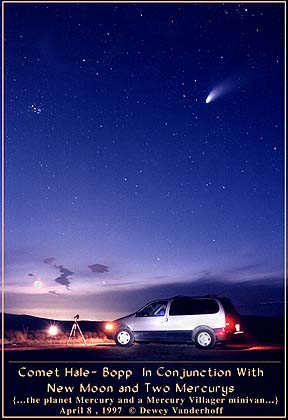
The third image, "...Two Mercurys..." is a tongue-in-cheek thing. We also observed and photographed the lovely conjunction of Mercury and the new crescent Moon. Andy drives a Mercury Villager minivan, so it seemed like the metaphorical thing to do to photograph a "Two Mercury" starscape.

I lit his van with a high-powered Krypton bulb flashlight filtered to approximate daylight with a blue 80-B photographer's studio gel. I took meter reading off his running lights and the flashlight beam to develop an exposure for "painting" in the vehicle.

The scene was photograhed for 40 seconds at f/ 2.8 on Fuji Super G 800 film using a Nikon F2AS camera with a Nikkor 35mm f/ 2.0 lens The car got four seconds of exposure from the flashlight from 100 feet away, and I had Andy click on his lights for one second to add that illumination. The point of light off his front bumper is a car on distant US highway 14-16-20 coming from Cody , whose urban light pollution is visible in the distance.

It is remarkable enough to be able to use my Macintosh technology to predict the various apparitions of MIR , LANDSAT, the Shuttle et ux , which I've been doing for about six months now. But this orbital serendipity of MIR traversing the Comet'Head is magical. It then becomes just a case of applying the Old Photographer's Axiom for getting a great photo , to wit :

"F/ 2.8 and Be There !


April 8, 1997
01:55 UT

Author: David Hanon
Location: Soddy-Daisy, Tennessee
Optics: 300mm lens at f/2.8.

1 minute exposure on Kodak ppf 400 film.


April 8, 1997
02:42 UT

Author: Roy Parish
Location: Bellevue, Louisiana
Optics: 50-mm Nikkor-AI lens at f2, no filter. 10 minute exposure on Kodak PPF film.
Hale-Bopp in Perseus


April 3rd-6th, 1997
01:18 UT


April 3rd-6th, 1997
01:18 UT


April 8, 1997
01:18 UT

Author: Ian Griffin
Location: Astronaut Memorial Planetarium & Observatory, Cocoa (Florida)
Optics: Maksutov 12" f/5 telescope and SBIG ST8 camera.

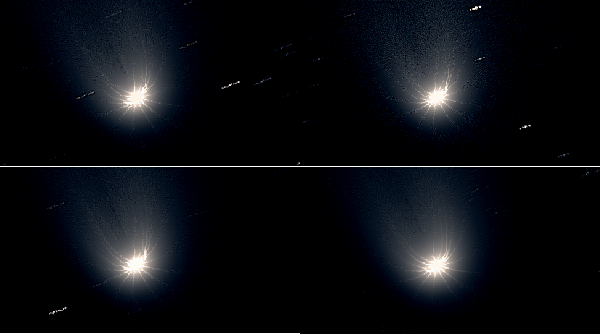
The jets of Hale Bopp: The image above was obtained from 25 x 20 second exposures of Hale Bopp, taken through a blue filter, combined and processed subtracting a masked version (5 x 5 pixel) from 105% of the original image.


The other two images show the activity for April 3rd-6th


April 7, 1997
20:02 UT

Authors: Alessandro Dimai, Renzo Volcan and Davide Ghirardo
Astronomical Association of Cortina
Location: Passo Giau 2300 mt, Cortina d'Ampezzo (Italy)
Optics: 300 mm f/2,8 lens.
3 minutes of exposure on Kodak PRO Gold 400 II hiper.
Hale Bopp near open cluster M 34 in Perseus.


April 7, 1997
19:15 UT

Authors: Alessandro Dimai, Renzo Volcan and Davide Ghirardo
Astronomical Association of Cortina
Location: Col Drusciè Observatory, Cortina d'Ampezzo (Italy)
Optics: 35 mm f/2,8 lens.
2 minutes of exposure on Kodak PRO Gold 400 II hiper.
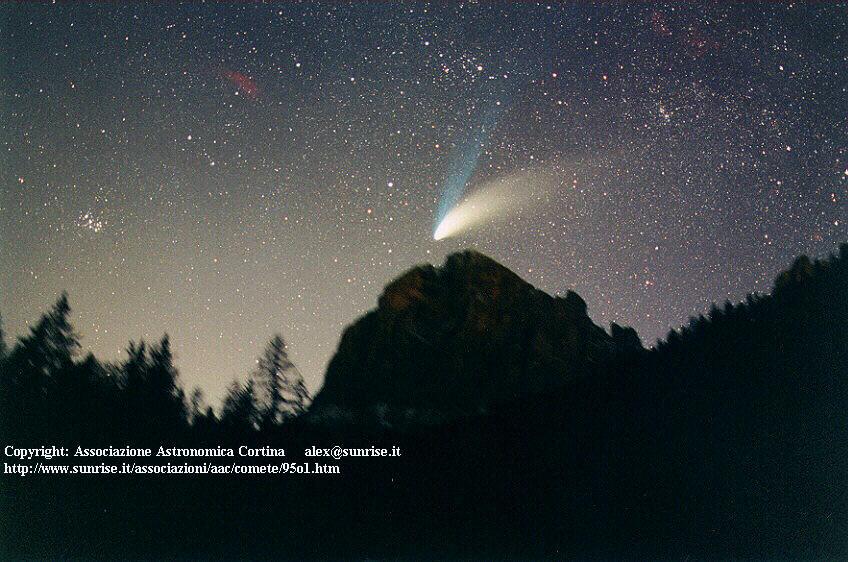
Hale Bopp over Tofana di Rozes (3224 m).


April 7, 1997
04:00 UT

Author: Wien-Xiang Song
Location: Lakeshore of Mendota, Madison, Wisconsin
Optics: 105mm f/1.8. 30 seconds on Kodak CE 100 film.


April 7, 1997
03:00-05:00 UT

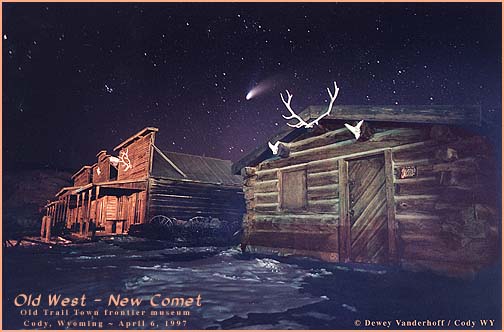
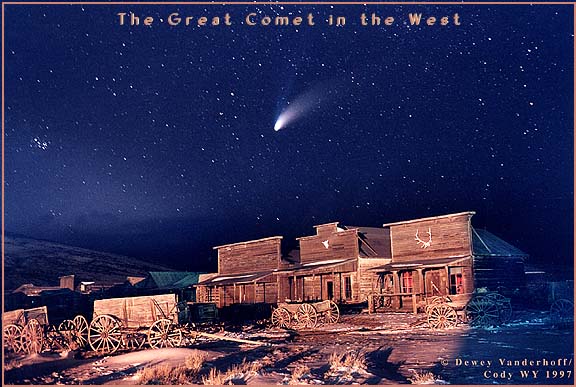
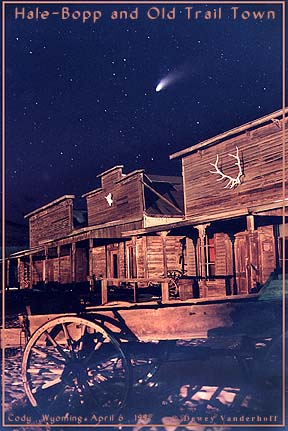
Author: Dewey Vanderhoff, Mack Frost, Andy Frazier
Location:Old Trail Town, Cody, Wyoming.
Optics: Nikon F2AS camera 35mm f/2 Nikkor lens on Fuji Super G- 800 print film.

We had a great run of comet hunting last night. The caretaker of the Old Trail Town frontier museum on the outskirts of Cody, Wyoming allowed us to shoot photos from within the ghost town buildings. It was an absolutely clear night; a storm pulling off left behind a crisp sky.

Using a combination of existing light from high powered sodium vapor lamps on the next property, and our own enhanced lighting tools, we lit the rustic old frontier buildings beneath Hale-Bopp and the star fields. Normally, sodium lamps are a photographer's curse ( the monochromatic light cannot be filtered or color balanced ) , but on the old weathered wood of the Trail Town buildings it added a golden patina.

The photos were scanned from handprinted 8 x 10 color glossies with little correction in Photoshop , except to remove a greeenish cast in some shadow zones, owing to a vagrant mercury vapor lamp shining in from a nearby trailer court...aaarrrggghh!!!.

Exposures were in the 25- 45 second range at apertures from f/ 2.0 to f/4.0 and we lit parts of the scene with a powerful flashlight filtered with studio gel filters to convert tungsten color back towards daylight. The buildings were "painted" with the light using 4 second brush strokes, exposure determined with a Minolta-IV incident light meter.

Special thanks to Terry Edgar, caretaker of Old Trail Town in Cody for allowing us access to the museum, normally closed during winter. Trail Town is a magical collection of genuine old West buildings and memorabilia by any reckoning, but at night with a comet hovering nearby, some of the romance and majesty of the West is recaptured in very visual metaphors.


April 7, 1997

Author: Gregory Terrance
Location: Lima, New York
800 mtrs of height ; 42.41 deg of Lat. ; 12.1 deg of Lon.
Optics: 200mm Olympus lens at f4, IMG1300 CCD camera from Finger Lakes Instruments. 5 minutes of exposure.

©1997 by Gregory Terrance.
This image may not be reproduced, published, or copied in any form
without written permission of the author.


April 6, 1997
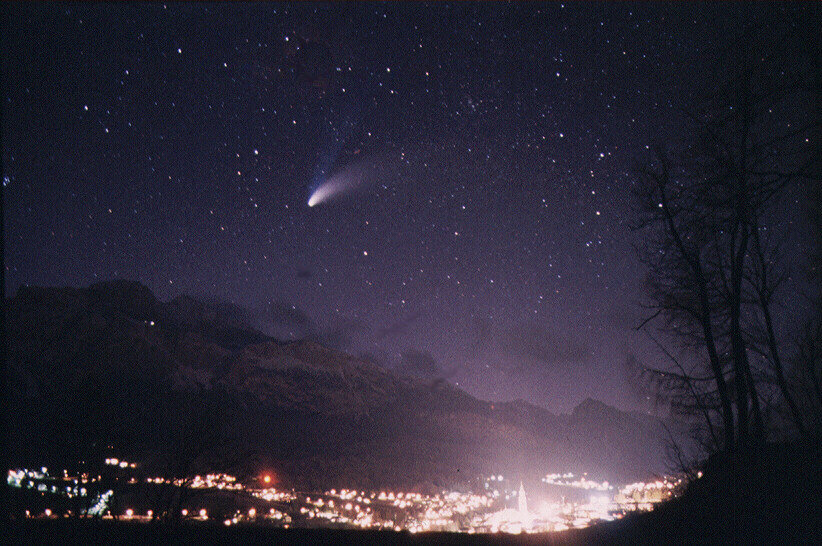
19:20 UT

Authors: Diego Gaspari and Giuseppe Menardi
Astronomical Association of Cortina
Location: Cortina d'Ampezzo (Italy)
Optics: 28 mm f/2,8 lens - Scotch 800-3200.
1 minute of exposure on Kodak PRO Gold 400 II hiper film.
Hale Bopp over Cortina.


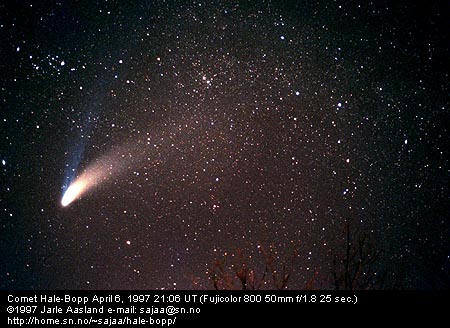
April 6, 1997
21:06 UT
25 seconds


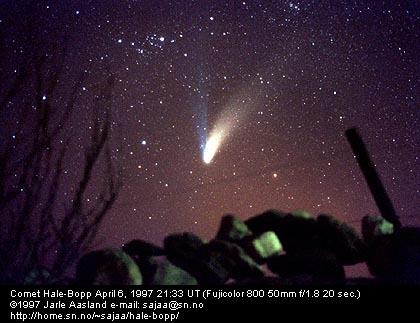
April 6, 1997
21:33 UT
20 seconds

Author: Jarle Aasland (sajaa@sn.no)
Location: Stavanger, Norway
(Latitude: 58° 58' 12" North, Longitude: 5° 45' 0" East)
Optics: 50mm f/1.8 (unguided). Fujicolor 800 negative film

Hale-Bopp is spectacular in these images.


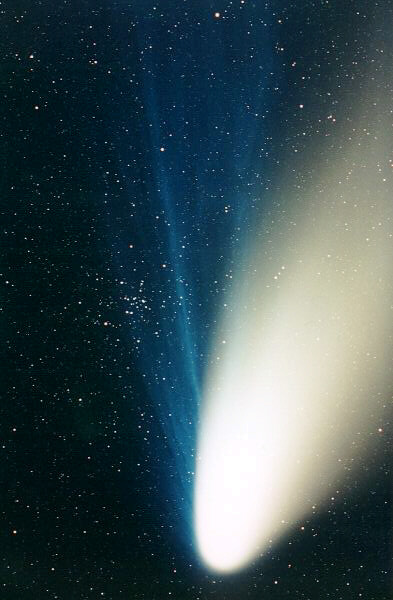
April 6, 1997
19:18 UT

Authors: Alessandro Dimai, Renzo Volcan and Davide Ghirardo
Astronomical Association of Cortina
Location: Col Drusciè Observatory, Cortina d'Ampezzo (Italy)
Optics: Takahashi FS 102, 600 mm f/6.
6 minutes of exposure on Kodak PRO Gold 400 II hiper film.
Hale Bopp near open cluster M 34 in Perseus.


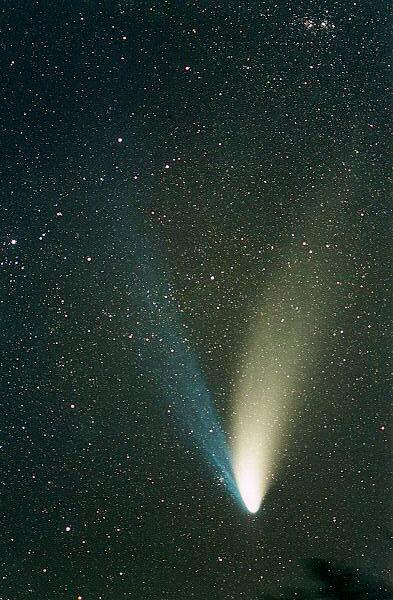
100mm f/2,8
April 6, 1997
19:55 UT

Authors: Alessandro Dimai, Renzo Volcan and Davide Ghirardo
Astronomical Association of Cortina
Location: Col Drusciè Observatory, Cortina d'Ampezzo (Italy)
3 minutes of exposure on Kodak PRO Gold 400 II hiper film.


April 6, 1997
21:00 UT

Author: Tim Printy
Location: Chiefland, Fla.
Optics: 200mm F/2.8 lens, Kodak PJM film.
6 minutes exposure. Guiding was on the comets nucleus.


April 6, 1997
21:15 UT

Author: Guided by Michael Voss, Grade 11.
Location: Sonderborg Observatory, Island of Als, Denmark
Optics: 135 mm Tamrock Photolens, compressed to f3.2. Fuji HG800 Press.

This image was obtained at the Amtsgymnasiet i Sondebørg of Denmark by the Astronomy Class (age 16-18).

5 minutes of exposure from the highest hill side on the Island of Als, "Hawk-Mountain". Sky conditions perfect, but icy cold winds. Notice the open star cluster Messier 34 to the upper left of the comet's nucleus, (position 10 o'clock). extremely dark sky. .


April 6, 1997
00:30 UT


April 6, 1997
00:30 UT

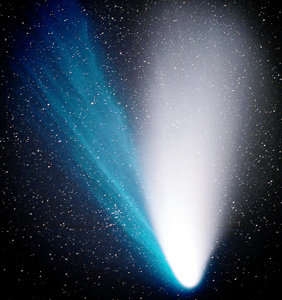
Author: Ian Griffin
Location: Astronaut Memorial Planetarium & Observatory, Cocoa (Florida)
Optics: Maksutov 12" f/5 telescope and SBIG ST8 camera.

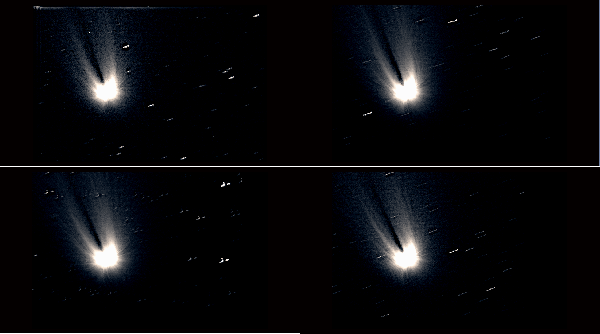
25 x 20 second exposures of Hale Bopp, taken through a blue filter have been combined and processed subtracting a masked version (5 x 5 pixel for the first image and a 20 x 20 pixel for the second image) from 105% of the original image.


April 6, 1997
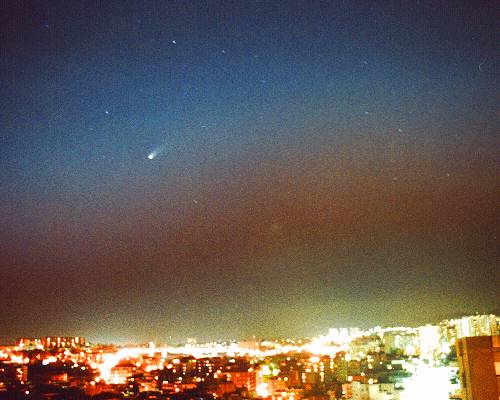
20:09 UT

Author: Anthony Parra
Location: L'Hospitalet del Llobregat, Catalunya (Spain)
Optics: 28 mm f/2.5. Kodak Ektar 1000. 40 seconds exposure.

L'Hospitalet is a satellite town of Barcelona. It shares with its big brother the same urban problems: heavy pollution (of any kind). This image was taken from a 13th floor, high above most of the neighbour buildings, on an abnormal evening of (almost) clear skies. The street at bottom right is Rambla Just Oliveras. Cornella's and Sant Just's buildings can be seen in the skiline. I covered the lens partially during 25 of the 40 seconds exposure, to avoid overexposing the bottom part.


April 6, 1997
20:15 UT

Author: Anthony Parra
Location: L'Hospitalet del Llobregat, Catalunya (Spain)
Optics: 55 mm f/2.8. Kodak Ektar 1000. 45 seconds exposure.

This image was taken from a 13th floor at l'Hospitalet. Some clouds started to veil the western horizon. They eclipsed the comet 30 minutes later. I covered the lens partially during 30 of the 45 seconds exposure, to avoid overexposing the bottom part.
(click here for a bigger version)


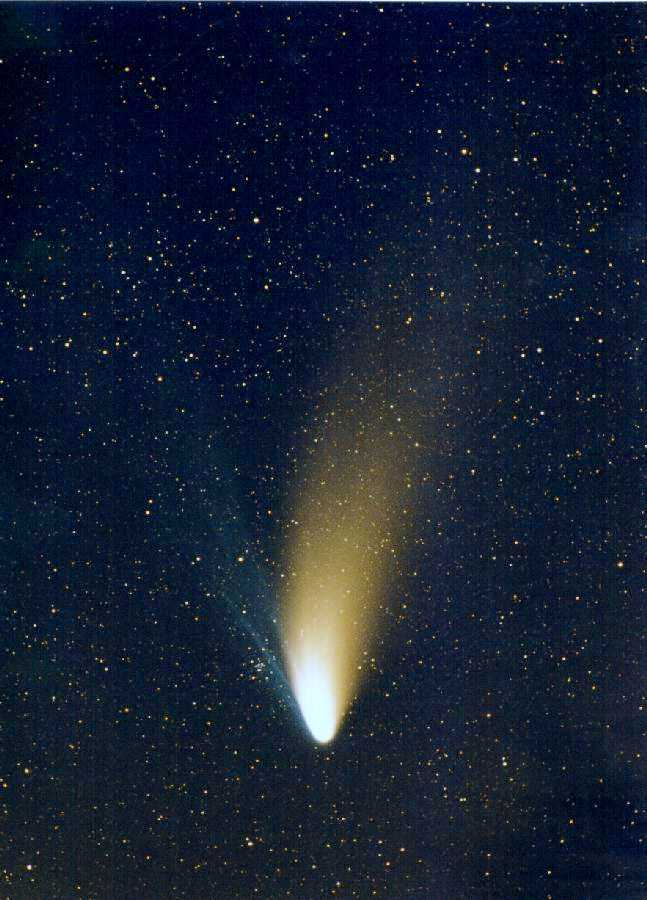
April 6, 1997
19:33-19:45 UT

Author: Herman Mikuz and B. Kambic
Location: Crni Vrh Observatory (Slovenia)
Optics: 19-cm, f/4 Flat-field S-C camera.
Exposure: 12 minutes on Kodak Ektacolor ProGold 1000 film (6x7 format).

High resolution image (313K)

Copyright © 1997 by H. Mikuz & B. Kambic.