Hale Bopp

Photographs: April 11 to 15, 1997


April 15, 1997

Stonebarn

Observers: Dewey Vanderhoff, Sean Campbell, Andrew Frazier 
Location: Wapiti Valley, Wyoming.
Optics:Nikon F2AS camera 35mm.
Exposure: 40 seconds at f/ 2.8 on Fuji Super G 800 

About 25 miles from of Cody, Wyoming on the eastern end of the McCullough Peaks badlands hills lies the abandoned "Stonebarn" cow camp , over 100 years old and built in the classic 2-story European fashion. It has a limestone first floor for mangers, and a gothic wood second story for a hay loft with a ventilator gable. It is a genuine piece of Old West and Wyoming frontier history, and made for a fine setting for a Hale-Bopp session on Tuesday night April 15. 

While we three photographers (myself, Mack Frost, and Sean Campbell) images the scene, Andrew Frazier painted the barn from 300 yards away atop a small hill, using the 400,000 candlepower spotlight and battery pack I built to do Hale-Bopp fill lighting with... it's daylight filtered with studio gels, and we took meter reading using my Minolta IV-F incident meter... 2 seconds per unit of area @ f/2.8 on Super G 800... that's bright! The picture was taken with a 35mm f/2.0 lens stopped down to f/2.8 for 40 seconds, give or take. Cassiopeia is directly over the barn, and the Pleiades are setting at the left edge of the scene. We also observed and photographed MIR this evening as well, rising obliquely over the barn and bisecting Cassiopeia. 
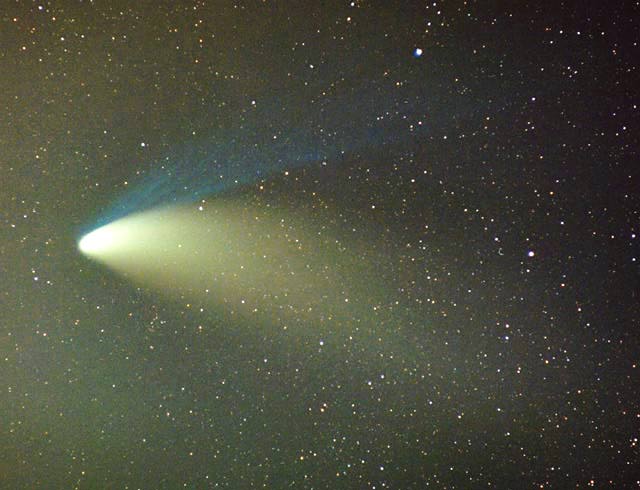
 
April 15, 1997
20:23 UT 
Author: Bengt Ask 
Location: a site 5 km from Svalov in southern Sweden (latitude 55d 54').
Optics:135 mm f/4. Fuji Super G 800 Plus film. 

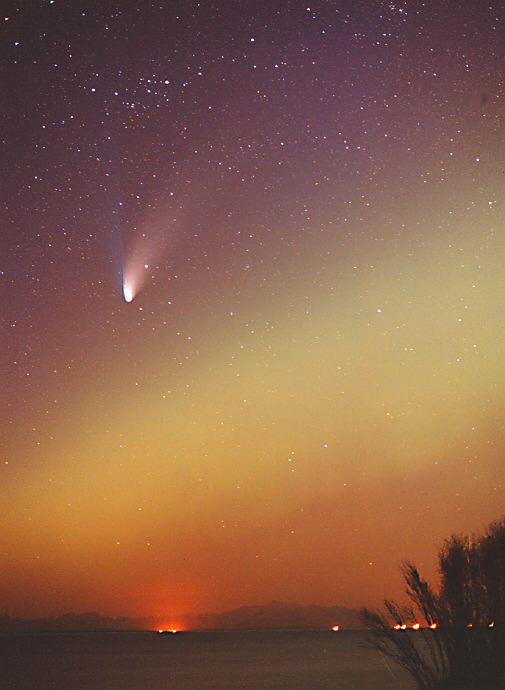
The picture was taken at 20.23 UT with a 135 mm lens stopped down to f/4. Exposure time 8 minutes. 

Copyright©1997 Bengt Ask 
 
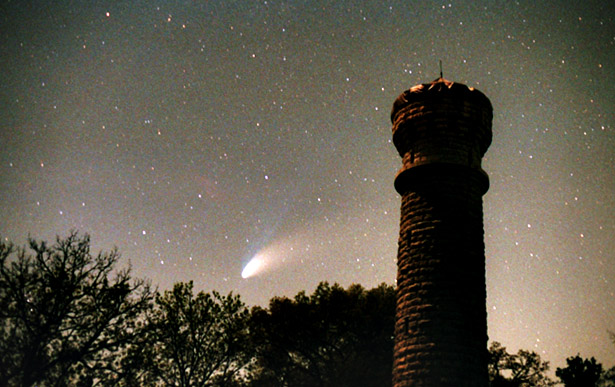
April 15, 1997
02:15 UT
Author: David Hanon 
Location: Fort Oglethorpe, Georgia 
Optics: 50mm lens at f/2.0. 30 seconds second exposure on Fuji Super HG 400 film 

The image shows the comet by Wilder Tower, a Civil War Memorial, in the Chattanooga/Chickamauga National Military Park in Fort Oglethorpe, GA. The scene is illuminated by the near 1st quarter moon. About 15 degrees of the gas tail can be traced out and the pink object above and to the left of the comet is the California Nebula. 

 
April 15, 1997

Hidden comet in the comet!

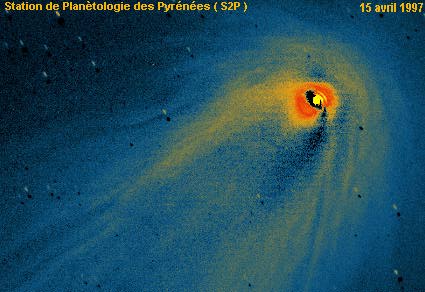
Authors: Francois Colas, Jean Lecacheux 
Location: Pic de Midi Observatory (France)
Optics: 105 cm telescope. 

As the sunlighted cometary dust observed through different broadband filters in the visible spectrum exhibits the same spatial repartition of luminosity, it is possible to cancel the dust tail accurately by subtracting two CCD images taken in different colours, providing that we have chosen the good coefficient of proportionality. Here we have subtracted a R image to a B image, the result of the process is an enhancement of the ion tail, whose brightness is manly due to the blue-violet CO+ emissions. Although modern photographic emulsions give excellent detection of the external ion tail, its near-nucleus part is hopelessly drowned in a ocean of light due the dust luminosity. Only computer processing of CCD images can restore it. 

This very simple method is able to reveal the hidden comet in the comet. It can be applied by amateur astronomers and is sufficient to make a rough hour by hour survey of the ion tail extensions and morphology. But it could be erroneous to derive quantitative flux measurements, as the red emissions of the H2O+ ion are subtracted in the resulting images, and consequently appear in negative ! A correct scientific work need observations with costly narrow-band CO+ , H2O+ and continuum interference filters. 

Copyright©1997 Pic de Midi Observatory.
Station de Planetologie des Pyrenees (France) 
 
April 1, 12, 13 and 14, 1997

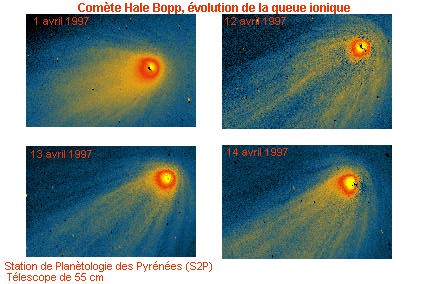
Evolution of the ion tail

Observers: Francois Colas, Cyril Birbaum, Eric Frappa, Laurent Jorda, Sylvain Champenois, Frank Boubault
Location: Pic de Midi Observatory (France)
Optics: 55 cm telescope. 

These images are the result of the subtraction of a "blue image" by a "red image" showing up the blue CO+ emission band at 426 nm after removal of the dust continuum. Ion streamers are clearly visible almost anywhere in the coma. The Images were taken at the F/3 prime focus of the 55 cm telescope. The goal of these observations is to see the evolution of the ion streamers. Is is clearly visible that the comet was not very active on April 1st. The activity of the comet ion tail from April 12th to April 14th have to be related with the recent solar eruption. 

Copyright©1997 Pic de Midi Observatory.
Station de Planetologie des Pyrenees (France) 
 
April 14, 1997
21:30 UT

Francesca with hale bopp

Observers: Francesca Lucentini, Marco Paolo Pavese 
Location: Genoa, Italy 
Optics:Nikon F4 camera 50mm AFD at f/4.
Exposure: 6 seconds on SCOTCH 640T ASA. 
 
April 13, 1997
02:30 UT

Christmas scene

Observer: Till Credner
MPAE (Max-Planck-Institut for Aeronomy, Germany)
credner@midws1.mpae.gwdg.de
Location: Pik Terskol, Kaukasus, Russia.
Optics:55mm at f/1.8.
Exposure: 30 seconds on Kodak Ektachrome 400 Elite II. 

Isn't there a nicer Christmas scene? Too bad that Hale-Bopp has gone. Comet Hale-Bopp was without any doubt a 'Great Comet', the Great Comet of the year 1997! Maybe also the Comet of the Century. 

The photography shows Hale-Bopp at the evening sky, seen from Pik Terskol Observatory in the northern Caucasus (Russia, Kabardino-Balkaria). The comet was just above the Elbrus, which is with 5642m altitude the highest mountain of the Caucasus. The snowy landscape was illuminated by the waxing moon. 

 
April 13, 1997
03:31 UT

Pillar and Trees

Observers: Dewey Vanderhoff
Location: Cody, Wyoming.
Optics:Nikon F2AS camera 35mm at f/2.8.
Exposure: 45 seconds on Fuji Super G-800 color print film. 

While the weather remains very cold, the sky was clear...our climatological luck is still running strong. The essential elements of good comet photography includes copious amounts of wool. The Comet hovers over the Black Mountain Obelisk in this scene taken from the edge of the Cody-Yellowstone highway at trout Creek in the Wapiti Valley. Passing cars illuminate the stands of cottonwood trees ( the Wyoming state tree , I might add... ). A five day old moon adds enough skyglow to increase the contrast between Black Mountain and the sky without taking too much away from the Hale-Bopp tails. 

 
April 12, 1997
03:15-06:00 UT

Observing the MIR space station

Observers: Dewey Vanderhoff, Mack Frost
Location: Cody, Wyoming.
Optics:Nikon F2AS camera 35mm f/2 Nikkor lens.
Exposure: 60 seconds on Fuji Super G-800 color print film. 

While you were at the Comet Chaser's gala in Pasadena last night, we were freeezing our appendages 10 miles east of Cody Wyoming photographing the MIR pspace station and Hale-Bopp once again. 

Using OrbitTrak 2.1.5 to get MIR's orbit, and plugging that file into ASTRO MPJ 1.4 for a starfield plot, we wre able to photograph the 200-ton station with the Comet at 10:30 PM- MDT ( 4:30 UT April 12 ). At the time, Mir was cruising over the US-Canada border about 890 range miles away over southern British Columbia. 

The photo shows Mack Frost observing thru binoculars while I photographed him from 100 feet away. I illuminated his pickup truck with a flashlight filtered for daylight ( 4 seconds lighting time on each swath of the truck ) . Mir is passing thru the central star at the "hinge" of Cassiopaiea. The comet is near Algol in Perseus, hovering over Heart Mountain on the horizon. 

 
April 12, 1997
03:15-06:00 UT

Roadside Distraction: a self portrait

Observers: Dewey Vanderhoff, Mack Frost
Location: Cody, Wyoming.
Optics:Nikon F2AS camera 35mm f/2 Nikkor AIS lens.
Exposure: 45 seconds at f/2.8 on Fuji Super G-800 color print film. 

The bright crescent moon, Pleiades. Orion, and Hale-Bopp float over a sub-luminal photographer alongside his friend Mack Frost's 1978 Chevrolet truck parked on Eagle Pass in the badlands of northwest Wyoming. 

Photographer outlined himself with his military surplus elbow flashlight with its night-vision red filter...any kind of body activity duirng long time exposures to stave off the wind chill helps... might as well make it a useful motion... 

 
April 12, 1997
03:15-06:00 UT

Spaceport

Observers: Dewey Vanderhoff, Mack Frost
Location: Cody, Wyoming.
Optics:Nikon F2AS camera 35mm f/2 Nikkor AIS lens.
Exposure: 45 seconds at f/2.8 on Fuji Super G-800 color print film. 

Looking back up Highway 14-16-20 towards Cody, Wyoming some ten miles away (down in a valley beneath the next ridgeline ). The four day old Moon, even as a relatively thin crescent, is way overexpoosed in this photo relative to the background sky objects and the Comet. But it adds a nice touch to Orion, the Pleaides, Hyades, Hale-Bopp and Co. We had just watched Mercury go over the NW horizon. The highway is lit up from passing traffic. 

 
April 12, 1997
03:00 UT

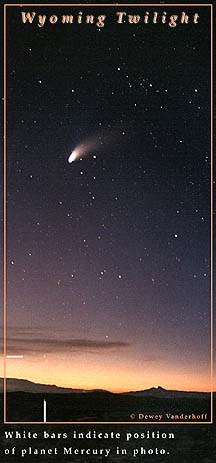
Wyoming Twilight

Observers: Dewey Vanderhoff, Mack Frost
Location: Cody, Wyoming.
Optics:Nikon F2AS camera 35mm f/2 Nikkor AIS lens.
Exposure: 45 seconds at f/2.8 on Fuji Super G-800 color print film. 

After watching the MIR space station literally "kiss" the Planet Mercury at 8:51 PM- MDT as it rose over the horizon, we followed the little planet as it set. The two lines along the lower left of the image frame point towards Mercury's location in the photo...it's popping out of the bottom of the clouds.

 
April 12, 1997
03:00 UT

Light pollution

Observers: Dewey Vanderhoff, Mack Frost
Location: Cody, Wyoming.
Optics:Nikon F2AS camera and Tokina 80-200 mm f/2.8 ATX lens (at 135 mm) .
Exposure: 15 seconds at f/2.8 on Fuji Super G-800 color print film. 

An interesting view of Comet Hale-Bopp about to pass behind landmark Heart Mountain ( 8400 feet) as seen from the eastern edges of urban cody Wyoming at midnight Friday April 11 ( 6:00 UT April 12). Horrendous light pollution and humidity aside, it was a spectacular vista for an urban perspective. But after observing Hale Bopp for the past four hours from a vantage in the badlands desert away from city lights and nearly a thousand feet higher in elevation, it was a dramatic contrast ...the lack of contrast, actually. It emphasized to me and my firned Mack frost how inportant it is for people wanting a serious view of Hale Bopp in its remaining visage to GET OUT OF TOWN! Head for the country, folks. 

anti reflections and ghost images from the bright city lights were removed in Photoshop to restore the scene to what we saw at the time. After the comet passed behind the mountain, the tail was still visible. It was eerie! like a plume of smoke. But this image here was my last frame of film from two rolls shot that night.

Some of the best pictures are the ones you don't take... 

 
April 12 1997
10:00 UT
Author: Bill Hutchinson (hutch@corecom.net)
Location: Kenai National Wildlife Refuge, Alaska 
Optics: Nikon N90 50mm f/2.0, 20 seconds on Fuji 400 Super G. 

2AM Saturday the 12th and, although a bit less colorful, the aurora still engulfs Hale-Bopp in its green haze while streaks of purplish spires sachet side to side.

Copyright© 1997 Bill Hutchinson
The Kenai Peninsula Eagle Press® 
 
April 11, 1997
20:31 UT
Comet Hale Bopp at Algol and Rho Persei. Faint meteor to the left. This image (180 Sec photo, Fuji sG800 +, 2031 UT + 3 min.) was obtained with a 135 mm f/3,5 camera at the Amtsgymnasiet i Sondebørg of Denmark by the Astronomy Class (age 16-18). 

Sky conditions : increasing moonlight, high clouds coming in.

 
April 11, 1997
Comet Hyakutake
April 1996

Hale-Bopp & Hyakutake at Perseus 

Author: Bill Hutchinson (hutch@corecom.net)
Location: Kenai National Wildlife Refuge, Alaska 
Optics: Nikon N90 50mm f/2.0, 25 seconds on Fuji 400 Super G. 

As the auroral show continues, Hale-Bopp points earthward to the Kenai Airport. This is the photo I've been waiting to shoot all Spring. The comet has crossed the path taken by Hyakutake one year earlier. It now lies in nearly the same spot on the same date 365 days later. My shot of Hyakutake's passing this spot was featured on the cover of The Planetary Society Magazine last summer. The similarities in these two photos are eerie.

Copyright© 1997 Bill Hutchinson
The Kenai Peninsula Eagle Press® 
 
April 11 1997
Author: Bill Hutchinson (hutch@corecom.net)
Location: Kenai National Wildlife Refuge, Alaska 
Optics: Nikon N90 20mm f/2.0, 30 seconds on Fuji 400 Super G. 

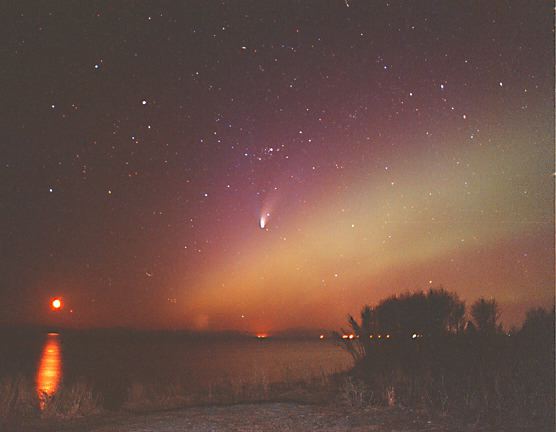
The northern lights spectacle continued into the early morning hours of the 11th. Hale-Bopp is surrounded by a purple hue that descends into the lights of Kenai, Alaska. A moonglade on Cook Inlet and the constellations add even more excitement to this very "busy" photograph.

Copyright© 1997 Bill Hutchinson
The Kenai Peninsula Eagle Press®