Hale Bopp

Photographs: April 16 to 20, 1997


Last update: April 30, 1997


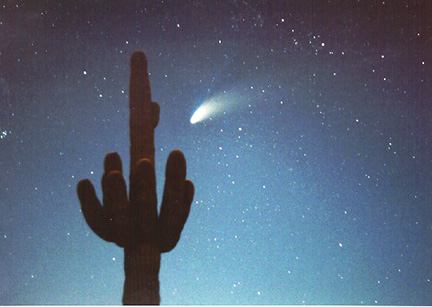
April 20, 1997

Observers: Eric Rosen
Location: White Tanks Regional Park, Arizona
Optics:Pentax P30T 50mm F2.8 lens.
Exposure: 30 seconds on Fujicolor 1600 film.
These pictures were taken at White Tank Mountain Regional park west of Phoenix Arizona. The exposure time (approx. 25-30 seconds) does not cause much star trails in the picture.


April 20, 1997

Winter Stars and Hale-Bopp receding

Observers: Dewey Vanderhoff, Mack Frost, Andrew Frazier, Sean Campbell
Location: Near Cody, Wyoming.
Optics:Nikon F2AS camera 24mm. Fuji SuperG 800 film.
Exposure: f/ 2.8 for forty seconds.

As Hale-Bopp pulls away from both Earth and the Sun , the favorite starfields of Winter seem to be going with it. This view from the Riddle Flats in the bottom of Sunlight basin shows (from left) the king of stars, Sirius; all of Orion; Aldeberan and the Hyades ; and Hale Bopp. The mountain at the right is the remnants of a volcanic caldera known as White Mountain, named for the bright mineral on its flanks.


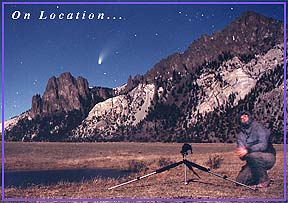
April 20, 1997

On Location

Observers: Dewey Vanderhoff, Mack Frost, Andrew Frazier, Sean Campbell
Location: Near Cody, Wyoming.
Optics:Nikon F2AS camera 24mm. Fuji SuperG 800 film.
Exposure: f/ 2.8 for forty seconds.

I included this self-portrait to illustrate some of the environmental aspects of landscape based astrophotography. For one thing, the wind was howling , and it drove the windchill to well below zero. In order to get a stable image, it is necessary to keep the camera and tripod close to the ground. The Bogen 3020 series tripods excel at this, since their legs lock at various angles outward, and you can anchor the unit by planting the centerpost on the ground, too ( Shown). The layers and layers of warm clothing were barley enough in the wind: Patagonia caprilene longies ; wool sweater and Gore-Tex jacket, and my trusty Swedish Army wool combat pants are standard issue for Wyoming night photography.


April 19, 1997

Author: Bill Hutchinson (hutch@corecom.net)
Location: Kachemak Bay, Homer, Alaska
Optics: Nikon N90 50mm f/2.0, 20 seconds exposure on Fuji 400 HG.

Our "daylight" comet visits the shores of Kachemak Bay at Homer, Alaska. The moonlight is so bright now that midnight seems like daylight to an open camera lens.

Copyright© 1997 Bill Hutchinson
The Kenai Peninsula Eagle Press®


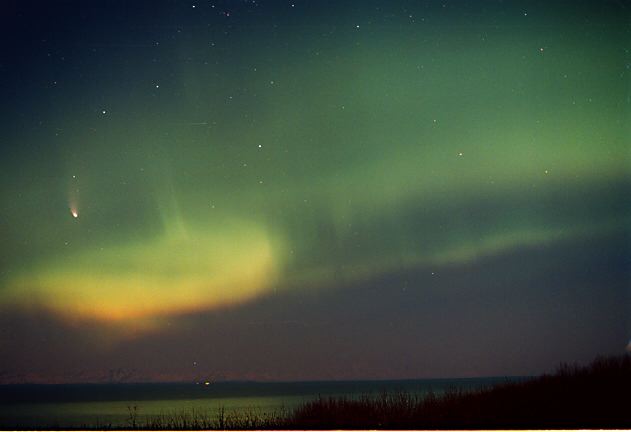
April 19, 1997

Author: Bill Hutchinson (hutch@corecom.net)
Location: Kenai National Wildlife Refuge, Alaska
Optics: Nikon N90 50mm f/2.0, 15 seconds exposure on Fuji 400 HG.

In the very early morning, the aurora borealis started to dance across Cook Inlet. The aurora grows across to engulf the entire Inlet and forms a huge pillow shape under Hale-Bopp. Heavenly sights indeed.

Copyright© 1997 Bill Hutchinson
The Kenai Peninsula Eagle Press®


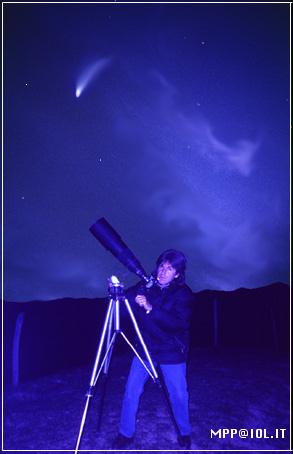
April 18, 1997
21:10 UT

Observers: Francesca Lucentini, Marco Paolo Pavese
Location: Savona, Italy
Optics:Nikon F4 camera 50mm AFD at f/1.4.
Exposure: 5 seconds on Kodak Gold 1000 ASA + flash.


April 17, 1997
01:03 UT

Author: Tim Puckett
Location: Puckett Observatory, Mountain Town (Georgia)
Optics: 30 cm Meade LX200 reflector working at f/7.

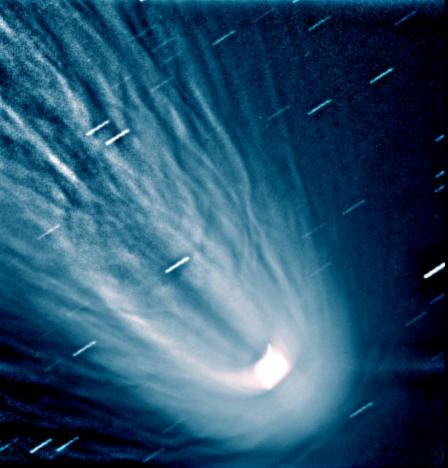
This is a Composite of 50 - 10 second exposures taken with an Apogee AP-7 CCD camera. The first exposure was taken on 04-17-97 at 01:03:44 UT. The images were enhanced to show the jets from the nucleus.

Copyright©1997 Tim Puckett


April 17, 1997
05:15 UT

Pillar and Trees

Observers: Dewey Vanderhoff, Mack Frost, Andrew Frazier
Location: Wapiti Valley, Wyoming.
Optics:Nikon F2AS camera 35mm at f/2.8.
Exposure: 45 seconds on Fuji Super G-800 color print film.

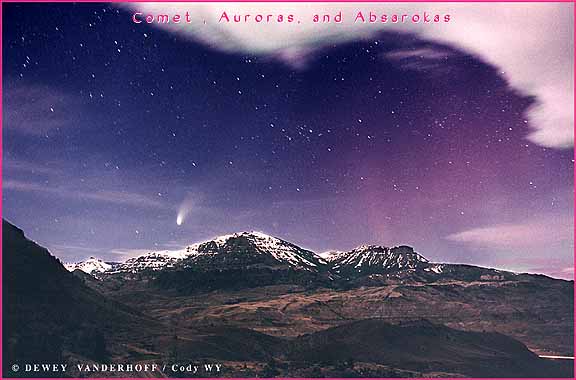
This scene was photographed in the volcanic highlands of the Wapiti Valley west of Cody, Wyoming on Breteche Creek, about 25 miles east of Yellowstone Park on Wednesday April 16 at 11:15 PM - MDT ( 5:15 UT April 17)
While most comet observers lament the return of waxing moonlight as detrimental to Hale-Bopp photography, we thrive on it. The enclosed image of Hale-Bopp hovering over Jim Mountain in the Absaroka Range of northwest Wyoming is a good case in point. Fuji Super G-800 has remarkable low-light color perception, capturing colors the human eye cannot percieve. Notice the display of auroras at the right , above the skyline and under the clouds. The crimson and truquoise auroras were only a grey smudge in the sky to us --- we thought they were distant clouds somewhere over Montana --- but the Fuji film and Nikkor lenses saw them for what they were ( they showed up plainly in the 3 x 5 Minilab proof prints... I used Photoshop's Contrast/Brightness and Color Balance filters to add a slight amount of contrast and blue filtration to the sky to make the northern lights stand out for low-res Internet viewing. The landscape appears normally here, thanks to the light of the 8-day old Moon. While the waxing moon is slightly diminshing the twin blue ion tails of Hale-Bopp, the advantages of gaining foreground illumination more than compensate. Remember, we're landscape-oriented astrophotographers. Trust us... the best scenes of the Comet over the Wyoming landscape are yet to come!


April 16, 1997

Mir rising - Weston Cabin

Observers: Dewey Vanderhoff
Location: Wapiti Valley, Wyoming.
Optics:Nikon F2AS camera 35mm.
Exposure: f/ 2.8 and Be There...

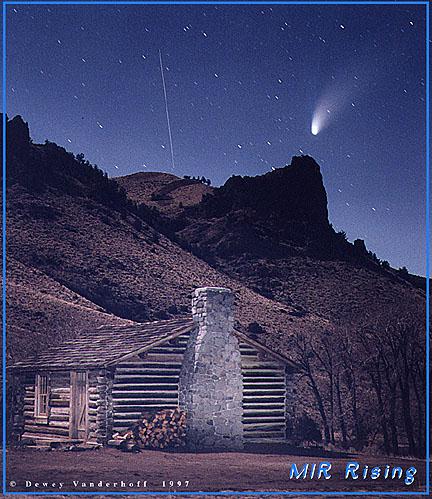
The following evening, Thursday April 16, we had plotted Mir and were ready for it. From our vantage near the historic Weston Cabin at the Breteche Creek Ranch Retreat in the volcanic highlands of the Wapiti Valley , we succeeded in capturing MIR rising alongside Hale-Bopp in the west. It came up behind the ridge and went straight up past the comet and Capella thru Auriga, and upon reaching 44 degrees elevation , it promptly passed into the earth's shadow and winked out. But Mack Frost and me got four frames of it.


April 16 1997
22:30 UT

Author: Joe Silke
Location: Dublin, Ireland
Exposure: 10 seconds at f 2.8 50mm on Fujicolor 800 Super G Plus film.

Hale Bopp taken over the Church of Ireland in Castleknock Dublin. Spire is illuminated by street lights from the right. Scanned at 300 dpi on a Epson GT9500 from the print.

Copyright© 1997 Joe Silke


April 16, 1997

High Trail to Hale-Bopp

Observers: Dewey Vanderhoff, Sean Campbell, Andrew Frazier
Location: Wapiti Valley, Wyoming.
Optics:Nikon F2AS camera 35mm.
Exposure: 40 seconds at f/ 2.8 on Fuji Super G 800

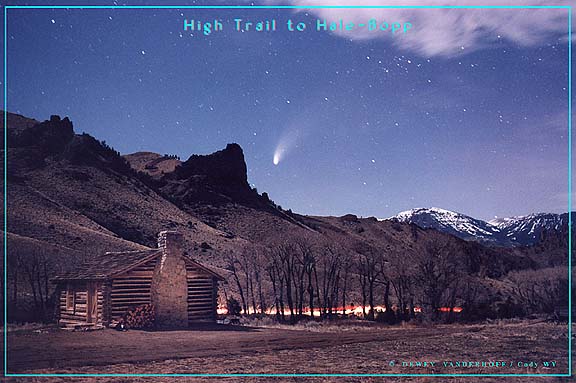
Here are some of the results of the last two night's worth of Comet and western landscape photos from Wyoming. Now that the Moon is waxing again, we have the opportunity to illuminate landscapes under Hale-Bopp. Given that the Comet is very cooperative and the weather in Wyoming is exceedingly mild and clear (how abnormal for April!) , we have hopes of getting some outstanding starscapes in the next few days. We must be the only serious observers on Earth who look forward to more moonlight. So be that as it may

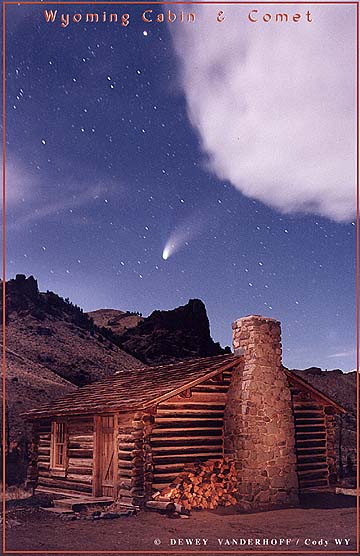
This photo was taken Wednesday evening at the Breteche Creek Ranch Retreat , high in the volcanic ridges above the Wapiti Valley of northwest Wyoming. Operated as a non-profit educational institution based around a classic old Wyoming cattle ranch and high country rangeland, the BCRR is a natural for comet observation, with its fine crisp air and spectacular landscape and views. We arranged a small "star party" there Wednesday to show the folks and friends the Comet, a blazing pass of the Mir space station, and an unanticipated display of crimson and truquoise auroras. The appearance of a magnificent bolide meteor exploding near Hale-Bopp was a nice touch, too. It shows some of the guests leaving... their car lights trailing thru the cottonwoods and aspens along Breteche Creek past the historic (refurbished) Weston Cabin under Hale-Bopp.
Jim Mountain and the snowcapped Absaroka Mountains loom in the background, some 12 miles distant across the Shoshone River valley. Landscape was lit by an 8-day old waxing moon. The cabin was partially illuminated by a flashlight to fill in the shadows with a warm glow.


April 16, 1997

Observers: Dewey Vanderhoff, Sean Campbell, Andrew Frazier
Location: Wapiti Valley, Wyoming.
Optics:55mm Micro-Nikkor lens on Nikon F2AS.
Exposure: Fuji 800 at f/2.8 for... long enough

A closeup of the aforementioned Weston Cabin at the Breteche Creek Ranch Retreat in the high basin above the Wapiti Valley between Cody Wyoming and Yellowstone Park. Taken Wednesday night, April 16 , we set up to observe a spectacular passage of the MIR space station straight up over the cabin and alongside Hale-Bopp , which we captured several frames of (* will post tomorrow...don't want to give the web tribe too much at one time...). The cabin was lit by a small flashlight...the tungsten bulb gives the wood a warm glow on daylighht film. The bright star straight above Hale-Bopp is Capella in Auriga.

The clouds of a dissipating layer of snowpack evaporation and afternoon cloud making actually add a nice touch to the scenes. Bretetche Creek Ranch Retreat, operated during summer months, is an outstanding dark sky site with all the amenities.


April 16, 1997

Observers: Don Pollacco, Isaac Newton Group on La Palma
Location: Santa Cruz de La Palma
Optics:2.5m Isaac Newton Telescope and CoCAM wide-field CCD camera.
Observations carried out in the past few days to study the distribution of sodium atoms in Comet Hale-Bopp have led to the discovery of a new type of comet tail. Sodium atoms have previously been seen near the centers of other comets, but these observations reveal for the first time in Hale-Bopp a straight tail of sodium atoms 6 degrees long.

At the instigation of Gabriele Cremonese of the Padova Astronomical Observatory Italy, a member of the European Comet Hale-Bopp Team, Don Pollacco of the Isaac Newton Group made several exposures of the comet through a narrow filter that isolates emission from sodium atoms.

Whereas the well-known ion and dust tails so prominently displayed by Hale-Bopp show a large amount of structure, the new sodium tail has a completely different appearance. It takes the form of an approximately 600,000 km wide and 50 million km long tail, in a direction close but slightly different to that of the ion tail. While the electrically charged particles in the ion tail are accelerated to large velocities by the solar wind (very fast atomic particles emitted by the Sun), there is no obvious explanation at this moment of how the observed sodium tail is formed. Nevertheless, the astronomers in the team believe that the sodium atoms may be released in-situ from very small dust grains or molecules. These particles or molecules are emitted by the cometary nucleus and then transported into the tail at high velocity by at present unknown mechanisms.

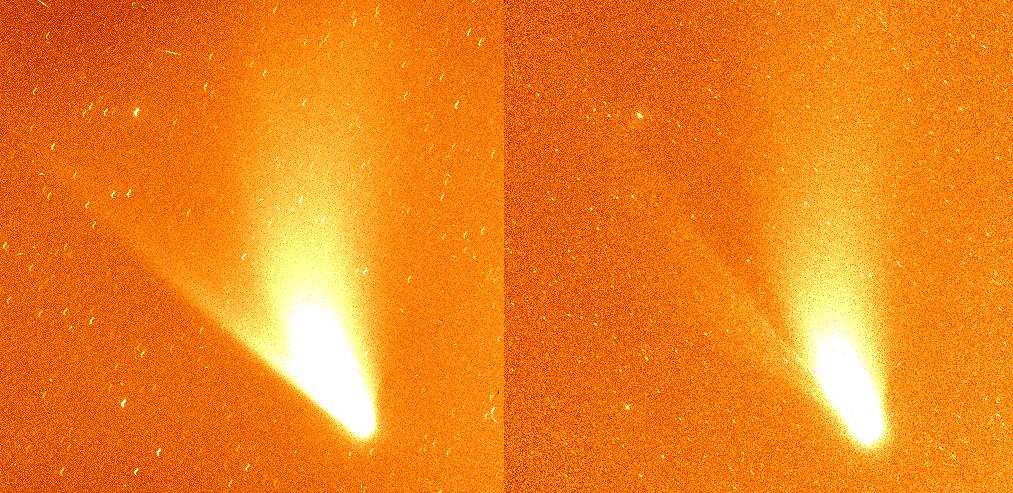
The picture on the left is the discovery image of the sodium tail in Comet Hale-Bopp taken on the 16th April 1997. The tail appears as a very straight narrow feature extending from the head of the comet to the upper left. The picture on the right is an image of Comet Hale-Bopp showing the ion and dust tails of the comet, taken a few minutes before the discovery of the sodium tail. The dust tail is the broad tail pointing straight upwards, while the ion tail is the filamentary structure to the left. Comparison of the two images shows how the sodium tail has a completely different appearance to the other tails of the comet.