Evidence from a variety of scientific fields indicates
that we might be the lonely inhabitants
of a vast cosmic ocean.
________________________________
by ROBERT NAEYE
________________________________
Courtesy Astronomy Magazine
(July 1996)
(All photos NASA, except where other source mentioned)
|
|
Humans thrive nearly everywhere on Earth. From the sweltering Amazon rain forest to the bone-dry Sahara Desert, and from the frigid Arctic wastelands to isolated Pacific islands, people have adapted to hostile conditions. Is the Milky Way Galaxy like planet Earth, with towns and cities dotting the landscape? Or is Earth more like a lonely island in a vast galactic ocean, with life bearing and specially intelligent life separated by vast distances? On the surface, the most obvious evidence bearing on these questions is the fact that our home world and host star seem so ordinary. Nicolas Copernicus shattered the prevailing notion that Earth was seated at the center of creation. Succeeding generations of astronomers steadily reinforced the Copernican view as they discovered the true nature of stars, the remote location of our home world within our Galaxy, and the existence of galaxies far, far beyond our own. So pervasive is this view that in the world of modern science, it is almost considered heresy to assert any special qualities to our solar system, our planet, or even ourselves. With an estimated 200 billion stars in the Galaxy and interstellar space filled with the molecules necessary for life, many scientists and laymen naturally conclude that we could not be alone -we must share our Galaxy with hundreds, thousands, or perhaps millions of other civilizations. But on closer examination, this simple logic falls apart. Recent studies in a variety of scientific fields suggest that life must pass through a series of bottlenecks on the road to intelligence. On Earth, a long sequence of improbable events transpired in just the right way to bring forth our existence, as if we had won a million-dollar lottery a million times in a row. Contrary to the prevailing belief, maybe we are special. Maybe humanity stands alone on a fertile island in the largely sterile waters of the galactic ocean. |
|
|
Scientists who ponder this deep question are limited
by the fact they have only one example of life to study: life on Earth.
Science-fiction writers have envisioned an amazing variety of life-forms totally
unlike any on our planet. But sci-fi writers are limited only by their imaginations,
not by physical reality. Life as we know it, from astronomy aficionados to the lowest
bacteria, shares several fundamental characteristics, and most scientists think
these will be common to all life in the universe.
First, the life takes in matter and energy from its surroundings, uses it for food, reproduction, and locomotion, and expels waste. Second, life stores information and replicates it in the future generations (that's a fancy way of saying "sex"). The liquid state is ideal for these tasks. Liquids can dissolve both solids and gases, producing complex molecules. And those molecules can move about freely and come into contact with other molecules hastening chemical reactions. In gases, atoms lie too far apart to allow the formation of complex molecules capable of storing information. And in solids, molecules are locked in place, so chemical reactions necessary to transfer information from generation to generation proceed much more slowly than in liquids. On Earth, where all life is based on the liquid state, 3.8 billion years elapsed between the first microbes and fast food restaurants. If life on another planet were based on solids, the time needed for intelligent life to evolve would be longer than the age of the universe. Intelligent life not only needs to be based on a liquid, it probably needs to be based on liquid water. On Earth, water is literally the molecule of life, comprising 70 percent of a cell's mass. There are good reasons to think this will be true elsewhere. Water is the most abundant molecule in the universe likely to be found in a liquid state and it has a wonderful ability to dissolve inorganic chemicals so living organisms can use them. Other liquids, such as ammonia, don't share water's versatility. It's no coincidence that the only body in the solar system with liquid water on its surface -Earth- is the only known life-bearing world. Some life-forms in the universe might be based on other liquids, but most biologists think the ones most likely to evolve high intelligence will be based on water. This stablishes a rather stringent requirement for intelligent life: It needs a stable temperature for billions of years so water can remain in a liquid state. |
|
|
To evolve intelligence, life needs a star that
can serve as an incubator for a life-bearing planet by providing relatively stable
temperatures for billions of years. But only a small fraction of the Milky Way
Galaxy's 200 billion star's fit the bill.
One that fits it perfectly is the Sun. This middle-aged star has a slightly above-average size and mass, and it produces a steady energy output. But the Sun, unlike the majority of stars, has no stellar companion. Roughly two-thirds of Milky Way stars belong to binary or multiple star systems. In most multiple star systems, either planets won't form, or varying gravitational forces will yank planets into tortured, elongated orbits. At one point in its orbit a planet will come very close to a star's searing heat, causing liquid water to evaporate. At other times it will venture far, far away, and water will freeze as temperatures plunge to a few degrees above absolute zero. Intelligent life could never evolve on such planets. Most single stars cannot support life either. Somo 80 percent of all stars -those with less than 65 percent of the Sun's mass- are just too wimpy to support life because they radiate so little energy. A planet close enough to recieve enough heat to keep water in a liquid state will orbit so close that tidal forces from the star will slow the planet's rotation to a crawl, as happens for Mercury and the Sun. One hemisphere faces the star for extended periods of time, becoming too hot, and the other faces away, becoming too cold. Many of these dwarf stars also spew huge flares into space thar periodically toast any nearby planets. On the other end of the scale, stars 40 percent more massive than the Sun or larger don't live enough to produce technological civilizations. These celestial behemoths, wich make up about one percent of the Galaxy's total, consume their hydrogen fuel like hungry sharks at a feeding frenzy. On the cosmic time scale, they live out their lives in a blink of an eye. The Sun belongs to a precious minority of stars that have no stellar companions and that have the right mass. Nobody knows exactly how many stars can support intelligent life, but it's clear these criteria have put a dent in the most optimistic ET claims by whittling 200 billion stars down to perhaps 10 to 20 billion. |
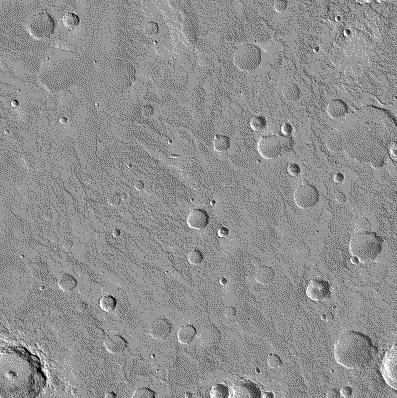 A magnetic field creates the aurora, but also protects a planet's surface from deadly radiation.
Ten or 20 billion good suns is still a lot of good suns. But how many have planets that can support life? The discovery of planets orbiting the Sun-like stars 51 Pegasi, 70 Virginis and 47 Ursae Majoris, has fueled the optimism of extraterrestrial life proponents. But on closer inspection, the new planets paint a less rosy picture. The planet orbiting 51 Pegasi is a Jupiter-mass world orbiting so close to its star that it's baked to a searing 1000 degrees. Most astronomers think the planet formed much farther from its star and then migrated inward due to tidal interactions with the disk from wich the planet formed, stopping just short of a fiery death. But if the system once contained terrestrial planets, they weren't so lucky. Astronomers think terrestrial planets will spiral into their parent star -and their doom- if the protoplanetary disk is long-lived. The 70 Virginis planet has been touted as a good life-bearing candidate because it lies in a zone where water can exist in liquid form. But the planet has a highly elliptical orbit, subjecting the world (and any moons that might be orbiting it) to wild climate variations. Moreover, the planet is so massive (at least 6.5 times that of Jupiter) that its elliptical orbit would completely eject any inner planets from the system. Of all the new planetary systems discovered to date, the 47 Ursae Majoris is the closest analog to our own. But even that system offers little prospect for life. Most astronomers think Jupiter's immense gravity prevented a planet from forming in the asteroid belt. The 47 Ursae Majoris planet, being at least 2.3 times more massive than Jupiter and closer to its star, would play havoc with the planet-formation process within the star's life zone.
But astronomers have unsuccessfully searched several dozen nearby Sun-like stars for Jupiter-mass planets in Jupiter-like orbits, suggesting that gas giant planets might be relatively uncommon. Computer models indicate that a planet needs at least 10 million years to gobble up enough gas from a protoplanetary disk to attain the mass of Jupiter. Radio observations of nearby stars only a few million years old show that most are not surrounded by enough gas to form heavy-weight planets like Jupiter. So for a solar system to be habitable, it needs to form from a disk that lives long enough to enable a Jupiter to reign in sufficient gas, but not so long that the terrestrial planets spiral all the way into the star. Our solar system might be one of the few where everything happened just right to give life a fighting chance. |
|
|
Many astronomers bemoan the Moon as a
worthless hunk of rock that washes out the night sky for about two weeks every month.
But without the Moon, there might not be anyone on Earth capable of enjoying the wonders
of the universe. Compared to the other terrestrial planets, the Earth-Moon system stands out.
Mercury and Venus have no satellites at all, and Mars has two insignificant, Manhattan sized
boulders that are probably captured asteroids. Earth can brag about its massive Moon,
however, wich is about the same size as the largest satellites of Jupiter and Saturn.
It's no wonder that many astronomers refer to the Earth-Moon system as a double planet.
Research by Jacques Laskar and colleagues at the Bureau des Longitudes in Paris shows that the Moon's considerable gravity acts as a stabilizing anchor on Earth. Without the Moon, subtle gravitational effects from the other planets (mainly Jupiter) over millions of years would play havoc with the tilt of Earth's spin axis. Instead of the current 23.5-degree tilt, wich gives us our moderate seasonal variation and wich varies by only 2.6 degrees over a 41,000-year period, the axial tilt would fluctuate chaotically between 0 and 85 degrees over millions of years. Earth's climate would experience eons of wild seasonal variation, followed by periods with none at all. Such unstable environmental conditions would probably lead to either a runaway greenhouse effect, which heats Venus' surface to a hellish 450 degrees Celsius, or runaway glaciation, which would plunge Earth into a permanent ice age. Probably very few Earth-sized planets in the Galaxy have satellites as large as our friendly neighbor. Most astronomers think the Moon formed by a freak accident. Early in the solar systems' history, a Mars-sized object crashed into Earth at just the right angle so as not to destroy Earth, but to blast a hefty chunk of material into space that later coalesced into the Moon. This might have been a one-in-a-million event, but one that apperars necessary to have allowed intellingent life to evolve. But perhaps the most fortuitous circumstance of all is the fact that water remained in a liquid state as the Earth and Sun went through major changes. When Earth formed 4,6 billion years ago, the Sun was 30 percent dimmer than it is now, according to stellar evollution models. At the time, Earth had a totally different atmosphere. It started off with an atmosphere consisting mostly of nitrogen, carbon dioxide, and carbon monoxide. Over billions of years, biological and geological activity removed most of the carbon from the atmosphere and replaced it with the free oxygen that now provides sustenance for all animal life. Remarkably, as the Sun heated up, and Earth's atmosphere completely changed over in composition, Earth's average temperature remained confined within a narrow range conductive to life, always staying between 5 and 60 degrees Celsius. How has Earth managed to avoid either a runaway greenhouse effect or a permanent ice age? Geologists propose that a global thermostat ensures the atmosphere becomes neither too hot nor too cold. Volcanism and the motions of shifting oceanic and continental plates cycle carbon between the atmosphere and the interior. When Earth's climate cools, the process allows carbon dioxide levels in the atmosphere to rise. Since carbon dioxide is a greenhouse gas that traps heat, this warms the planet. When the Earth warms up, the mechanism removes carbon dioxide from the atmosphere, so the planet cools. This thermostat, many Earth scientists believe, has mantained a stable climate for eons. How many planetary systems in the Galaxy orbit a good sun, have a Jupiter, and have a rocky planet with both a large moon and a perfectly working thermostat? No one can say for sure, but it's probably a very small number. The moral of the story is that good planets are hard to find. |
Even if we assume that life originates on a good planet orbiting a good sun, it's by no means inevitalbe that a species with high intelligence will ever evolve. Many evolutionary biologists think the evolution of a highly intelligenct species like Homo sapiens was a one-in-a-billion long shot. In his book Wonderful Life, Harvard paleontologist Stephen Jay Gould corrects the common misconception that evolution is a "march of progress" toward increasingly advanced life and intelligence. Instead, as Gould explains, the evolution of life is like a tree. Homo sapiens, like all of Earth's modern species, is but one tiny twig at the end of a long chain of increasingly smaller branches. No single twig is more "advanced" than any other twig; evolution does not work toward a goal. Gould's Harvard colleague Ernst Mayr argues that the evolution of a twig capable of high technology is exceedingly improbable. He notes that only one of the four major kingdoms of life, the animals, went on to produce intelligence. Only one of the 70 phyla of animals, the chordates, produced intelligence. Only one class of chordates, the mammals, produced intelligence. Only one order of mammals, the primates, and only one family of primates, the great apes, produced high intelligence. And only after 25 million of years of evolution and many failed lineages, did one particular ape evolve that was capable of high technology.
Our own lineage went through through millions of species. Because evolution is primarily a game of chance, any seemingly minor past event could have gone slightly different, cutting off our evolutionary line before humans evolved. ET proponents should be deeply discouraged that none of the millions of other lineages, representing the billions of species that have inhabited Earth during its existence, have made substantial progess toward high intelligence. Unlike the development of eyes, wich have evolved independently at least 40 different times in Earth's history, there has been no evolutionary "convergence" toward high intelligence. Intelligence may have evolved several times, but only in humans was it combined with the manual dexterity needed to make tools. And that combination seems to be the key that allowed humans to develop their high technology. |
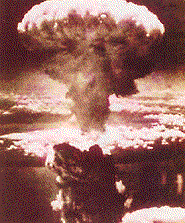 Nuclear Armageddon, pollution,
 asteroid impacts, and other disasters can extinguish a civilization. What is our fate? (Photo National Archives) The long series of bottlenecks makes it clear that the emergence of intelligent life is far more difficult than scientist once thought. There are probably more obstacles that scientist haven't even stumbled across yet. The origin of life on Earth, for example, might have been the ultimate long shot. ET proponents might counter that this line of reasoning is based on mere anthropocentric speculation. Maybe life and even intelligent life can take on various forms that we can't even imagine. But alternative life-forms are the epitome of speculation. If one chooses to shun speculation and stick solely with observations, one can ask the same question that Nobel physicist Enrico Fermi put forth in 1950: If the Galaxy is teeming with intelligent life, where are they? The sobering reality is that there is no observational evidence whatsoever for the existence of other intelligent beings anywhere in the universe. If intelligent life is commonplace, our current astronomical instruments could possibly see evidence of their activities. But as UCLA astronomer Ben Zuckerman points out, there is no hint that the hand of technology has touched the universe. He notes that the Infrared Astronomical Satellite could have detected heat radiation from large-scale space colonies or astroengineering projects around several hundred Sun-like stars. Even recognizing the vast distances between the stars, it's hard to imagine that all technological civilizations will remain confined to their home planetary systems. Just 40 years into our Space Age we have four probes leaving the solar system. In the year 1900 anybody would have laughed at the proposition that such an event would take place before the end of the century. With scientific knowledge doubling every 20 years, it would be equaly shortsighted to rule out interstellar travel. If the Galaxy is teeming with technological civilizations, some of them will overcome the problems of interstellar travel and venture into deep space. Some will launch automated probes to explore other star systems. Some will send emissaries to colonize other planets. Others will migrate when their sun's hydrogen-burning life-cycle ends. When civilizations do venture into the Galaxy, our solar system, with its nurturing Sun and wealth of resources, will be a lucrative target. But UFOs, faces on Mars, and ancient astronauts notwithstanding, there's not a shred of credible evidence that Earth or even our solar system has ever been visited by extraterrestrials. Even if ETs have a "Prime Directive" prohibiting interference with life on Earth, they would be tempted to exploit the vast supply of iron, nickel, and other minerals in the planets and asteroids. But our solar system appears totally pristine, as if no outsiders have been here before. This evidence is far from definitive. Extraterrestrials could be in our solar system right now, with cloaking technology that hides them from our view while they patiently wait for us to mature. When scientists are confronted by multiple explanations for a phenomenon, they generally apply Occams' razor: Accept the simplest explanation with the fewest assumptions and reject the more fantastic and convoluted explanations. Perhaps the Galaxy is bustling with life and civilizations. But the simplest explanation, given the evidence in hand, points in the direction that we share the Galaxy with few others, or none at all. The most optimistic ET claims are often put forth by the scientists who listen for radio signals from extraterrestrial intelligence. The search for extraterrestrial intelligence (SETI) represents a relatively inexpensive experimental approach to this profound question. And although the chances of picking up a signal are slim, it certainly does no harm to look. But radio searches suffer because a negative result provides no information whatsoever about the preponderance of technological civilizations. Moreover, the discovery of quasars, pulsars, and the cosmic microwave background teaches us that if other civilizations inhabit the Galaxy, the first hint of their existence will likely come about by pure serendipity. But until that happens, it seems prudent to conclude that we are alone in a vast cosmic ocean, that in one important sense, we ourselves are special in that we go against the Copernican grain. If so, humanity represents matter and energy evolved to its highest level; whereby a tiny part of the universe on a small rock orbiting an average star in the outskirts of an ordinary spiral galaxy has brought itself to a state of consciousness that can ponder the questions of how the universe, and life itself, began, and what it all means.
Robert Naeye is an associate editor for ASTRONOMY. He hopes the folks who search for extraterrestrial intelligence soon prove this article wrong.
|
Date: Mon, 7 Oct 1996 07:57:04 -0500 (CDT)
To: Antoni Parra
From: rnaeye@astronomy.com (Robert Naeye)
Subject: Re: ET
((I wish I put this into my article!):
If you took the entire 3.5 billion year history of life on Earth and represented it with the Eiffel Tower in Paris, the amount of time that high intelligence (human beings) has been on the planet would be represented by the layer of paint at the top! What this means is that high intelligence occupies only an infinitesimal portion of a planet's history. So unless some civilizations are extremely long-lived, meaning they endure for hundreds of millions or billions of years, they will flicker in and out of existence like fireflies in the night. But if some civilizations can endure for hundreds of millions of years, they're going to venture out into the Galaxy, and we should see some hint of their existence.
Regards,
Bob Naeye

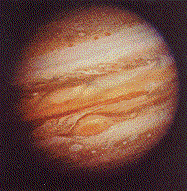 Astronomers have good reason to think that planetary systems like our own -with rocky
inner panets and gas giants starting at about Jupiter's distance from the Sun- offer the
best prospects for life. The rocky planets serve as the abodes for life, while the
massive planets cleanse the systems of most of the junk left over from the planet-formation
process. Recent computer simulations by George Wetherill of the Carnegie
Institution in Washington, D.C., show that without Jupiters, killer asteroids and comets
would constantly bombard any rocky inner planets. Instead of impact-induced mass extinctions
(like the one that wiped out the dinosaurs) occurring every 100 million years, they would
happen every 100,000 years. Life would never have the opportunity to evolve toward
intelligence.
Astronomers have good reason to think that planetary systems like our own -with rocky
inner panets and gas giants starting at about Jupiter's distance from the Sun- offer the
best prospects for life. The rocky planets serve as the abodes for life, while the
massive planets cleanse the systems of most of the junk left over from the planet-formation
process. Recent computer simulations by George Wetherill of the Carnegie
Institution in Washington, D.C., show that without Jupiters, killer asteroids and comets
would constantly bombard any rocky inner planets. Instead of impact-induced mass extinctions
(like the one that wiped out the dinosaurs) occurring every 100 million years, they would
happen every 100,000 years. Life would never have the opportunity to evolve toward
intelligence.